
Quick Summary
Commercial water damage restoration requires immediate, engineered structural drying to prevent catastrophic business downtime, hidden microbial growth, and severe structural degradation across complex facility envelopes. Wade's Restoration minimizes operational interruption by delivering 24/7 rapid emergency dispatch, industrial desiccant moisture extraction for dense building materials, and seamless single-team reconstruction paired with complete insurance documentation. Property managers will understand critical mitigation timelines, cost variables, and drying protocols, enabling them to contact Wade's Restoration for immediate commercial dispatch or request a comprehensive free visual inspection and written scope of work.
Commercial Water Damage Restoration: Stop Costly Downtime
When flooding hits a commercial facility, water extraction and structural drying must start immediately to protect inventory, safeguard building systems, and prevent downtime from compounding into massive financial losses.
Across commercial real estate, water damage is one of the most common commercial property insurance claims, accounting for 57% of processed commercial property claims. In older commercial buildings, a 24-hour delay can soak subfloors, ruin multi-layer wall assemblies, and trigger fungal growth inside structural cavities. Wade’s Restoration handles commercial recovery from emergency water extraction through complete reconstruction. Our technicians track psychrometric data daily and supply moisture maps, psychrometric readings, containment records, and itemized closeout documentation directly to your insurance adjuster to ensure your claim moves forward smoothly.[1]
Do not let standing water halt your operations. Contact Wade’s Restoration for 24/7 commercial emergency dispatch across Harrison, Jersey City, Hoboken, and Kearny, or reach out to schedule an on-site inspection and detailed written scope of work.
What Is Commercial Water Damage Restoration and How Fast Is Response Needed?
Commercial water damage restoration is the process of extracting standing water, stabilizing building environments, mechanically drying deep structural assemblies, and repairing commercial spaces after pipe bursts, sprinkler activations, sewer backups, or storm flooding. Emergency extraction should begin as promptly as possible to halt water migration into elevator shafts, electrical conduit, and subflooring, while complete structural drying typically takes several days to reach safe moisture equilibrium.[3]
Water losses represent the majority of commercial property claims. Cleaning up commercial flooding requires commercial-grade structural drying engineering rather than basic surface cleanup, especially in facilities with high occupant density or sensitive electronic inventory.[4]
The Critical Mitigation Window
Water spreads through building assemblies continuously until mechanical drying takes over. Starting emergency water extraction right away prevents moisture from saturating subfloors, ceiling plenums, and structural masonry. Standard 72-hour surface drying methods often fail commercial properties by leaving moisture trapped deep behind plaster, drywall, and brick. Wade’s Restoration provides 24/7 commercial dispatch throughout Harrison, Jersey City, Hoboken, and Kearny, using industrial extraction units and desiccant drying systems to stabilize commercial spaces fast.
Immediate Threats to Business Operations
Unchecked water creates compounding problems across commercial facilities:
- Structural Saturation: Standing water travels through floor plates, seeps into structural joists, and penetrates electrical infrastructure, creating fire risks and forced closures.
- Microbial Growth (24 to 48 Hours): Rising relative humidity allows mold spores to germinate on drywall paper and insulation, contaminating indoor air and multiplying cleanup costs.
- Documentation Deficits: Commercial insurers require exact psychrometric records, moisture mapping, and proof of containment to approve structural drying invoices and business interruption claims.
What Does Commercial Water Damage Restoration Cost?
Commercial water damage restoration costs typically range from $3,000 for isolated clean-water pipe leaks to $50,000 or more for major commercial flood cleanup projects involving multi-story contamination, heavy structural drying, or sewage backups.
Claim severity across commercial properties has climbed steadily due to rising material costs, specialized labor requirements, and commercial downtime expenses. The broader restoration sector continues to expand, reflecting how frequently commercial facilities face complex water emergencies. Final restoration expenses depend on three primary factors: the contamination category of the water, the total square footage affected, and the physical makeup of the building envelope.[2]
Key Cost Variables in Commercial Properties
Clean water from a supply line rupture (Category 1) costs significantly less to remediate than unsanitary gray water from appliances (Category 2) or contaminated black water from storm flooding and sewer mains (Category 3). Structural complexity also dictates equipment needs. Dense materials such as structural concrete, multi-wythe brick, and pre-war rubble-stone foundations require specialized desiccant dehumidification systems to draw out bound moisture, which requires more monitoring time than standard modern framing.
Wade’s Restoration provides free visual inspections and transparent, flat-price scopes of work before mitigation begins, giving property managers clear pricing without surprises.
The Commercial Water Mitigation and Drying Process Explained
Need commercial water damage restoration?
We’re available now - call for a fast, free estimate.
Commercial water mitigation relies on a structured three-phase protocol: rapid bulk extraction, deep structural dehumidification, and sanitization paired with rebuilding. Effective restoration focuses on removing bound water trapped within subfloors, concrete, and wall cavities to preserve structural integrity.
Phase 1: Emergency Water Extraction and Hazard Containment
Technicians inspect the property with thermal imaging cameras and penetrating moisture meters to map the boundaries of water migration before extraction begins. Crews isolate electrical panels, set up plastic containment barriers around unaffected areas, and extract bulk standing water using truck-mounted vacuum units.
Phase 2: Industrial Structural Dehumidification and Moisture Tracking
Crews deploy industrial low-grain refrigerant (LGR) dehumidifiers, desiccant units, and high-velocity air movers to pull moisture out of dense structural assemblies. Commercial structural drying projects typically require about 3 to 10 days, averaging 7 to 10 days of continuous mechanical drying to reach pre-loss moisture standards.
Phase 3: Sanitization, Antimicrobial Treatment, and Reconstruction
Technicians apply EPA-registered antimicrobials to exposed framing and masonry to prevent fungal growth. Once daily moisture logs confirm that framing and subfloors have returned to dry standard levels, our in-house reconstruction team steps in to replace insulation, hang drywall, and reinstall finished flooring.
Why Standard 72-Hour Drying Fails Pre-War Commercial Properties
Standard 72-hour drying schedules fail older commercial structures because short-term surface evaporation leaves bound moisture inside multi-wythe brick walls, rubble-stone foundations, and historic timber framing. Without extended thermodynamic desiccant drying, trapped moisture degrades sill plates, causes plaster delamination, and supports hidden fungal growth behind newly painted walls.
Deep-Core Moisture in Rubble-Stone and Brick Cavities
Unlike modern steel-stud construction, older commercial properties rely on multi-wythe brick and rubble-stone foundations that absorb massive volumes of water. Basic restoration crews often drop off standard fans for 72 hours, dry the outer surface, and leave while the masonry core remains saturated. True structural drying requires specialized negative-pressure setups and desiccant systems that pull moisture out from deep within structural assemblies.
Restoring Commercial Drywall, Ceilings, and Cavity Insulation
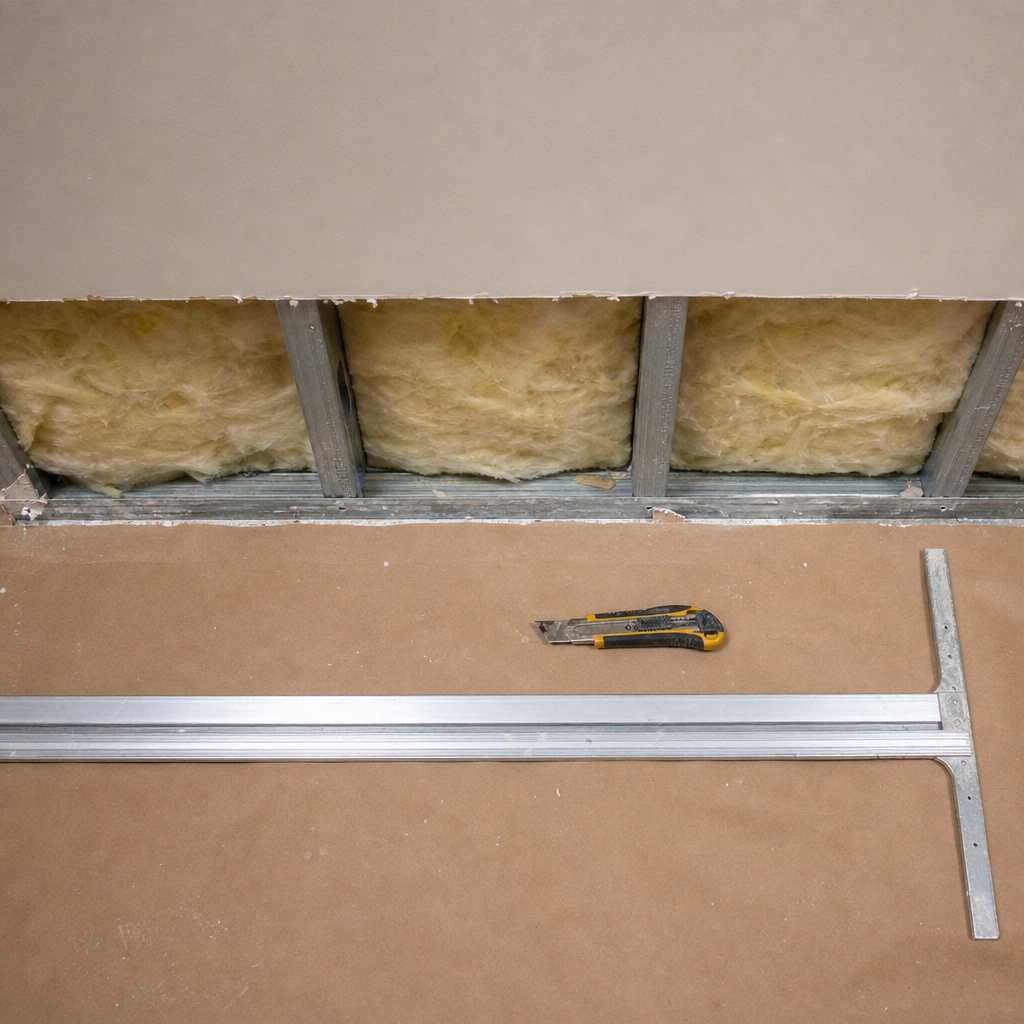
Restoring saturated walls and ceiling assemblies requires identifying moisture migration pathways that extend well beyond the visible water line. Drywall and insulation pull water upward through capillary action, demanding careful thermal scanning and precise flood cuts to stop mold from spreading behind finished surfaces.
Identifying Hidden Moisture Migration in Commercial Walls
Water frequently travels 24 to 48 inches above the floor inside interior wall cavities. In office spaces and retail facilities, impermeable vinyl wall coverings act as vapor barriers, trapping moisture inside the stud cavity and accelerating decay. Technicians use non-invasive moisture meters and thermal cameras to identify the exact height of the moisture boundary before making surgical cuts.
Repair vs. Replace Criteria for Commercial Wall Systems
Deciding whether to dry an assembly in place or remove materials depends on the insulation type and water contamination level:
| Wall Material | Moisture Impact | Restoration Protocol |
|---|---|---|
| Fiberglass Batt | Loses loft and traps moisture against wood or steel framing | In-place desiccant drying for Category 1; remove and discard for Category 2 or 3. |
| Blown-in Cellulose | Mats together, holds water, and loses thermal R-value | Requires removal via targeted flood cuts along the moisture line. |
| Vinyl-Faced Drywall | Traps moisture inside the cavity, preventing evaporation | Remove vinyl face or make horizontal flood cuts to allow cavity airflow. |
Making targeted flood cuts early in the mitigation phase allows air movers to dry internal framing directly without gutting entire rooms unnecessarily.
Handling Water Damage in Commercial Subfloors and Joists
Need commercial water damage restoration?
We’re available now - call for a fast, free estimate.
Restoring commercial subfloors requires drawing trapped moisture from beneath non-porous floor coverings before timber deflects or concrete slabs suffer adhesive failure. Technicians deploy targeted negative-pressure drying mats and dehumidification equipment to protect structural joists, concrete sub-slabs, and engineered decking from permanent damage.
Saving Commercial Hardwood, VCT, and Concrete Slabs
Water easily travels under vinyl composition tile (VCT) and commercial hardwood, pooling in areas where standard air movement cannot reach. Vacuum mat systems pull moisture vapor directly through wood planks and concrete pores under high negative pressure. Lowering the relative humidity at the subfloor level within 48 to 72 hours prevents adhesive breakdown, cupping, and sub-slab moisture pockets.
Preventing Subfloor Deflection and Structural Settlement
When structural subfloors remain wet, wood fibers expand and lose load-bearing capacity. Crews manage saturated subfloor assemblies using straightforward stabilization steps:
- Check for Delamination: Swollen, warped OSB or plywood with broken glue lines cannot support commercial floor loads and must be replaced.
- Stabilize Joists: Timber framing registering above 16% moisture content requires direct airflow into crawlspaces, basements, or dropped-ceiling plenums.
- Reinforce Damaged Spans: Heavily buckled subflooring is cut back cleanly to joist centers and rebuilt with matching material to preserve structural strength.
Navigating Commercial Property Insurance and Claim Documentation
Securing commercial insurance coverage for structural drying requires clean, organized documentation from day one. Insurance adjusters require clear proof that the equipment used, drying duration, and structural teardowns were necessary to stabilize the property.
Zone-Level Documentation Carriers Require
Commercial claims receive detailed scrutiny from insurance adjusters. Incomplete logs or unrecorded drying metrics can stall claim payouts. Field teams must supply precise data across every phase of the project:
- Zone-Level Documentation and Moisture Maps: Meter readings and detailed zone-by-zone moisture maps tracking moisture percentages across building assemblies from the initial inspection to final dry-standard verification.
- Daily Dry Logs: Daily records of temperature, relative humidity, and grains-per-pound (GPP) psychrometric readings tracking active moisture reduction inside every affected room.
- Equipment Records: Detailed logs of deployed dehumidifiers, air movers, and specialty drying equipment documenting continuous operation and performance.
- Tenant Impact Logs and Containment Proof: Clear tenant impact documentation and photographic proof of containment barriers, negative-air setups, and protected business assets.
- Indexed Closeout Packets: An organized, indexed closeout packet containing complete moisture maps, daily dry logs, equipment records, and floor plans confirming the structure is fully stabilized and dry.
Avoiding Disputed Claims and Business Interruption
Submitting vague invoices or missing daily logs often triggers adjuster pushback. Wade’s Restoration uses industry-standard estimating platforms and provides daily psychrometric updates directly to your insurance representative. This keeps your claim on track and prevents unexpected out-of-pocket expenses.
How to Choose a Commercial Water Mitigation Company
When choosing a commercial water restoration provider, prioritize local owner-operated teams with industrial structural drying equipment over national volume franchises that rely on third-party subcontractor networks. Look for firms with IICRC-certified technicians, deep-cavity desiccant drying experience, and in-house reconstruction capabilities.
Dedicated Commercial Response vs. Volume National Franchises
During heavy storms, national franchise call centers frequently dispatch third-party subcontractors who place standard fans, leave them for 72 hours, and bill your carrier without checking deep masonry or subfloor moisture. An experienced local team understands regional architecture and manages the job with dedicated equipment from start to finish.
| Feature | Wade’s Restoration | National Franchise Networks | General Contractors |
|---|---|---|---|
| Emergency Dispatch | Direct local response | Call-center routing queues | Next-day or variable scheduling |
| Structural Core Drying | Desiccant and deep thermodynamic drying | Standard 72-hour surface fans | Demolition without deep drying |
| Rebuild Management | Direct in-house team | Subcontractor handoff | Subcontracted trades |
| Workmanship Guarantee | 90-Day Done Right Promise | Varies by regional territory | Standard 30-day builder terms |
Single-Source Mitigation and Reconstruction
Hiring one contractor for water mitigation and another for rebuilding creates handoff delays, scheduling conflicts, and finger-pointing over pre-existing moisture issues. Managing drying, sanitization, and repairs under a single roof ensures smooth project transitions and clear warranty coverage.
Frequently Asked Questions About Commercial Water Damage Cleanup
Commercial water restoration protects building assets through rapid containment, industrial drying, and verified moisture tracking. Below are common questions property managers have when managing commercial water emergencies.
How much does commercial water damage restoration cost?
Costs generally range from $3,000 for small, clean-water leaks up to $50,000 or more for major commercial flooding events involving Category 3 water, multi-wythe brick saturation, or widespread structural demolition.
How long does the commercial drying process typically take?
Commercial structural drying projects typically take about 3 to 10 days, averaging 7 to 10 days to reach safe moisture equilibrium depending on the overall square footage, class of water intrusion, and structural density.
Does commercial property insurance cover water mitigation?
Sudden and accidental water damage is often covered under commercial property policies. However, flood damage usually requires separate flood insurance or an NFIP-type policy.
Can my business remain open during commercial water cleanup?
In many cases, yes. Technicians install heavy-duty plastic containment walls and run negative-air HEPA scrubbers to isolate the work zone, allowing unaffected areas of your business to operate safely while structural drying is underway.
Need commercial water damage restoration?
We’re available now - call for a fast, free estimate.
Sources
- Introduction to the National Flood Insurance Program (NFIP) – congress.gov
- Water Damage Restoration Industry Statistics | 2026 Edition – worldmetrics.org (2026)
- Property Restoration Industry Statistics | 2026 Edition – worldmetrics.org (2026)
- Managing Water Damage Risk Involves Planning, Diligence – credaglobal.org (2021)
Related reading: Flood Restoration Near Me | 10% Off & Free Estimate | Same-Day Service
Related reading: Water Damage Restoration Service – Call Now-10% Off – Same-Day Service – Free Estimate
Related reading: Water Damage Restoration Cost – 10% Off & Free Estimate – Same-Day Service
Frequently Asked Questions
What specific psychrometric documentation do commercial insurance adjusters require to approve structural drying claims?
Commercial carriers require daily logs detailing temperature, relative humidity, and grains-per-pound (GPP) moisture metrics across every affected containment zone. Wade's Restoration compiles comprehensive zone-by-zone moisture maps, equipment run logs, and indexed closeout packets directly for adjusters to prevent claim disputes and streamline payouts.
Why does deep-core masonry moisture in older commercial buildings require industrial desiccant drying instead of standard fans?
Dense assemblies like pre-war rubble-stone foundations and multi-wythe brick trap bound moisture deep inside structural cavities where conventional 72-hour air movers cannot reach. Wade's Restoration deploys industrial desiccant dehumidifiers and negative-pressure setups to draw moisture from deep within structural assemblies, stopping long-term structural decay and plaster delamination.
How does using a single-source contractor for both water mitigation and reconstruction reduce business downtime?
Handling extraction, drying, and structural repairs under one provider eliminates subcontractor handoff delays, scheduling conflicts, and disputes over pre-existing moisture. Wade's Restoration manages the entire recovery pipeline from emergency dispatch through final build-back, protecting project timelines with a 90-Day Done Right Promise.
About the author
 |
Sarah Higgins Sarah is a seasoned restoration specialist with over eight years of experience managing complex property recovery projects. Holding a B.S. in Construction Management from Rutgers University, she combines technical expertise with a compassionate approach to guide homeowners through stressful emergencies. Her writing focuses on practical advice for water damage mitigation, mold remediation, and navigating the insurance claims process. |
Water damage, flood, or mold emergency?
We’re available now - call for a fast, free estimate.
Call Now - Free Estimate