
Quick Summary
When dealing with sudden property flooding, finding rapid flood restoration near me within the first hour is vital to prevent mold growth, warped subflooring, and irreversible masonry decay. Wade's Restoration solves this urgency with a 45-minute emergency response across Harrison and Hudson County, managing everything from high-volume extraction and deep cavity drying to complete rebuilds and direct insurance coordination. Property owners can call Wade's Restoration 24/7 to dispatch an in-house, IICRC-certified crew immediately for fast water extraction and a free visual inspection.
Flood Restoration Near Me: 45-Min Fast Water Extraction
When water pours into your property, you need a certified crew on-site immediately to pump out standing water, protect the structure, and stop mold before it spreads. At Wade’s Restoration, our in-house, IICRC-certified technicians maintain a 45-minute emergency response time throughout Harrison and surrounding Hudson County communities. We arrive with truck-mounted extractors, industrial desiccant dehumidifiers, and thermal imaging cameras ready to stabilize your building. Instead of routing your emergency through an out-of-state call center or handing off tasks to unvetted subcontractors, our owner-operated team manages the entire process under one roof, from initial water removal to complete structural repairs. We also work directly with your insurance carrier, providing timestamped photo logs and daily moisture readings to keep your claim moving without out-of-pocket surprises. Call our 24/7 dispatch line now to get a certified crew en route and request a visual inspection.
How Fast Can an Emergency Flood Restoration Crew Arrive at Your Property?
An emergency flood restoration crew should arrive at your doorstep within 45 to 60 minutes. Rapid arrival limits water from soaking deeper into framing lumber, concrete subfloors, and shared brick walls, protecting the structural envelope before materials warp, swell, or delaminate.
Immediate Action Within the First 60 Minutes
The first hour of water intrusion often decides whether hardwood floors, wall framing, and subfloors can be dried in place or must be completely torn out. According to the Institute of Inspection, Cleaning and Restoration Certification (IICRC), microbial growth and secondary humidity damage can take hold within 24 to 48 hours of exposure. Starting professional water damage restoration services right away stops moisture migration before building materials absorb dangerous amounts of water.
Live Local Dispatch vs. Corporate Call Centers
Finding dependable flood restoration near you comes down to how quickly a company can get boots on the ground. National franchise chains often route emergency calls through corporate call centers, causing hours of delay while dispatchers search for available subcontractors in North Jersey. Wade’s Restoration operates a 24/7 local dispatch, sending our own certified technicians directly to your address. For homeowners and business owners in Harrison, Kearny, Jersey City, and Hoboken, direct local dispatch means fast emergency flood cleanup without third-party delays.
What Does Flood Restoration Cost in Harrison and Hudson County?
Professional flood restoration in Harrison and Hudson County generally costs between $1,500 and $9,500. The final price depends on the source of the water, the total square footage affected, and how deeply moisture has penetrated the building materials. Clean water cleanups sit on the lower end of the spectrum, while contaminated storm runoff or sewage backups require extensive decontamination and structural drying.
Itemized Flood Restoration Cost Breakdown
Standard industry pricing covers several distinct phases of work:
| Service Component | Estimated Cost Range | Scope of Work |
|---|---|---|
| Diagnostic Inspection & Moisture Mapping | $0 (Free) – $350 | Thermal imaging, moisture meter readings, and initial scope of work |
| Emergency Water Extraction | $1,000 – $3,000 | High-volume truck-mounted pumping and standing water removal |
| Structural Drying & Dehumidification | $1,500 – $4,500 | LGR and desiccant dehumidifiers, targeted air movers, and daily monitoring |
| Mold Prevention & Sanitization | $1,200 – $5,000 | EPA-registered antimicrobial application, HEPA air scrubbing, and containment |
| Category 3 Sewage & Silt Cleanup | $2,500 – $8,000+ | Biohazard removal, contaminated material disposal, and sanitizing |
Key Factors That Drive Total Water Extraction and Rebuild Pricing
The total cost for flood damage repair depends heavily on the water category. Category 1 water (clean supply lines) requires standard drying. Category 2 water (gray water from appliances or sump pump overflows) requires targeted sanitization. Category 3 water (black water from street flooding, Passaic River surges, or sewer backups) carries serious biohazards, requiring controlled demolition of porous materials and deep sanitization.
Building style also impacts equipment choices. Pre-war basements dried with basic fans often develop hidden mold colonies because moisture gets trapped inside dense masonry. Wade’s Restoration provides clear, itemized scopes of work before work begins so you know exactly what to expect.
The Threat to Older Properties: Why Surface Drying Fails Rubble-Stone and Brick Row Homes
Need flood restoration near me?
We’re available now - call for a fast, free estimate.
Surface drying fails older brick row homes and rubble-stone foundations because porous masonry pulls water deep into structural cavities through capillary action. Standard carpet fans dry only the surface layer, leaving gallons of moisture trapped inside shared party walls and foundation stones where it can rot framing studs and feed hidden mold colonies.
Capillary Action in Shared Brick Party Walls
In attached townhomes throughout Hudson County, historic brick behaves like a dense sponge. Water wicks upward and outward through shared party walls, moving into adjoining properties without showing obvious surface puddles. According to the IICRC S500 Standard for Professional Water Damage Restoration, porous masonry can pull moisture several feet vertically through capillary action. Standard flood cleanup that ignores this hidden moisture allows water to slowly break down lime mortar joints inside structural partitions.
The Moisture Trap in Pre-War Foundations
Pre-war rubble-stone foundations feature thick mortar beds and irregular stones that retain water behind their outer surfaces. When dealing with basement water intrusion in older Harrison properties, standard blowers simply dry the outside of the stone while leaving the core saturated, creating long-term structural issues.
| Drying Approach | Masonry Penetration Depth | Outcome for Pre-War Row Homes |
|---|---|---|
| Standard Surface Blowers | 0 to 0.25 inches (surface only) | High risk: Trapped core moisture causes crumbling mortar and hidden mold. |
| Industrial Desiccant Systems | Full structural cavity | Complete stabilization: Draws out bound moisture through vapor pressure control. |
Drying these structures thoroughly requires commercial desiccant dehumidifiers that establish strong vapor pressure differentials. Our technicians configure drying setups tailored to historic architecture, protecting the structural integrity of your building.
Restoring Flooded Basements and Rubble-Stone Foundations
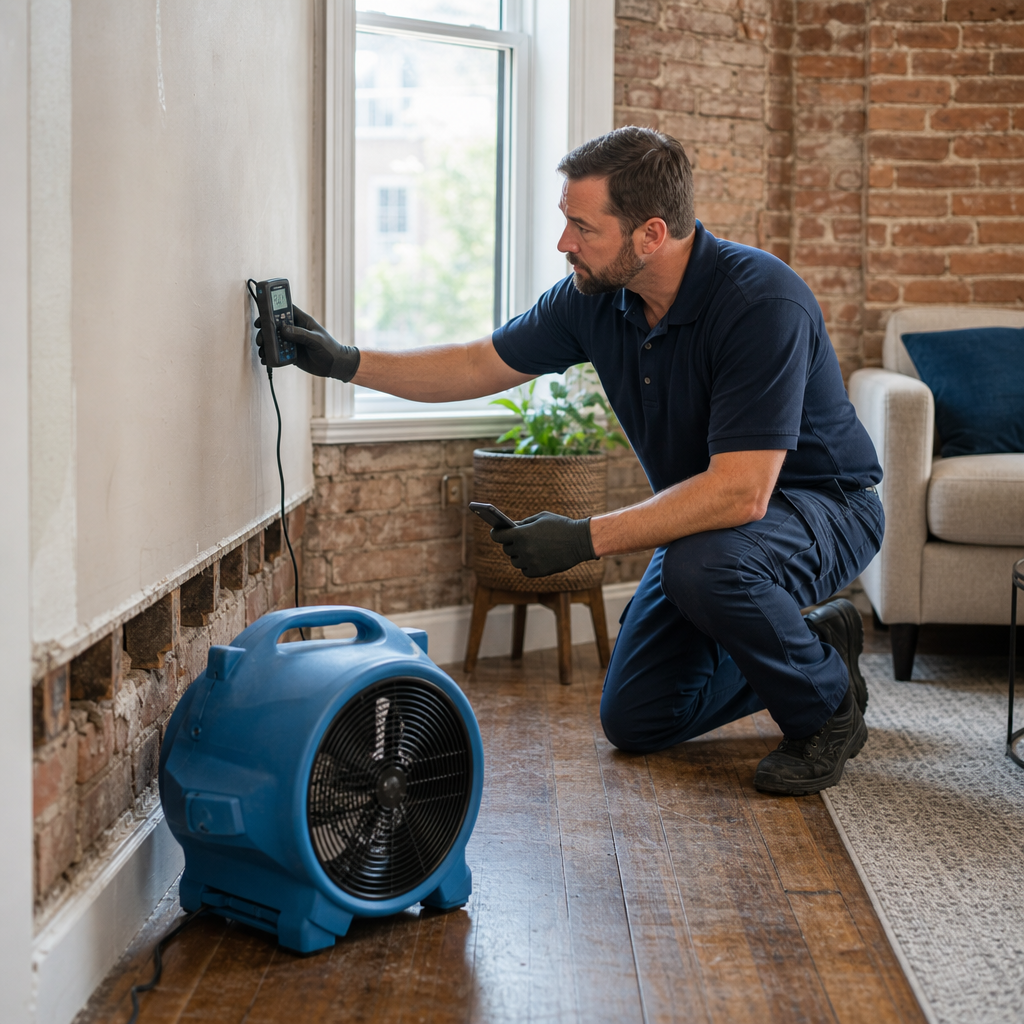
Restoring a flooded basement with a historic rubble-stone foundation requires deep water extraction, continuous low-grain dehumidification, and careful masonry monitoring. Wade’s Restoration uses high-lift basement flood extraction equipment designed for tight, urban basement access, removing standing water quickly to relieve hydrostatic pressure against your foundation walls.
Signs of Hidden Foundation Saturation
Because rubble-stone and fieldstone foundations absorb water rapidly, watch for these signs of deep moisture retention:
- Efflorescence: White, chalky salt deposits left on stone faces as moisture pushes outward and evaporates.
- Crumbling Mortar: Softened, sandy mortar joints caused by prolonged water exposure.
- Lingering Basement Humidity: Indoor humidity staying above 60% several days after visible water has been pumped out.
Repair vs. Replace: Pumps, French Drains, and Mortar Joints
Contaminated floodwaters leave behind silt and fine debris that damage mechanical drainage equipment. Sump pumps and electrical switches submerged in dirty water should be replaced to prevent sudden failures during the next storm. In contrast, clogged perimeter French drains can often be cleared with commercial hydro-jetting and treated with EPA-registered antimicrobials. Saturated stone mortar should be allowed to dry completely before being evaluated for repointing with breathable lime-based mortar.
When to Call for Immediate Commercial Extraction
Storm surges and river overflows introduce Category 3 blackwater containing raw sewage, street runoff, and harmful bacteria. The IICRC notes that Category 3 water intrusions require professional extraction and containment within 24 to 48 hours to stop deep structural damage and indoor contamination. When severe weather hits, our 24/7 team is ready to respond with commercial-grade extraction gear.
Rescuing Saturated Drywall, Plaster, and Hardwood Subflooring
Saving wet drywall, plaster, and subflooring requires precise diagnostic tools rather than immediate, uncontrolled demolition. Using thermal imaging cameras, regulated flood cuts, and negative-pressure floor drying mats, our certified technicians can often save architectural finishes while making sure the internal wall framing dries completely.
Identifying Water Migration Behind Walls
Water climbs inside wall cavities through capillary action and wicking insulation. Using non-invasive infrared imaging and moisture meters, our technicians map hidden moisture boundaries behind plaster, drywall, and baseboards to find damp insulation without tearing down unaffected walls.
Decision Rules: Historic Plaster vs. Drywall Cuts
Under the IICRC S500 Standard, contaminated Category 2 or Category 3 water intrusions require removing porous drywall and insulation at least 24 inches above the highest water line. Our restoration process follows clear steps:
- Containment and Moisture Mapping: Seal the work area and measure baseline moisture across all wall assemblies.
- Controlled 2-Foot Flood Cuts: Make clean horizontal cuts on drywall to remove soaked insulation while leaving upper wall sections intact.
- Preserving Historic Plaster: Save sound plaster over wood lath by introducing heated, dry air into stud cavities instead of tearing out original materials whenever safe to do so.
Drying Subfloors Under Hardwood and Tile
Water seeps between floorboards and settles into plywood subfloors, causing cupping and eventual rot. Rather than immediately ripping up expensive floors, we place sealed negative-pressure drying panels directly onto the surface. These high-vacuum systems draw moisture up through the wood grain to bring the subfloor back to its dry standard.
How to Choose Local Flood Damage Repair Over National Franchise Chains
Need flood restoration near me?
We’re available now - call for a fast, free estimate.
When selecting a restoration company, look for an owner-operated local contractor that manages both emergency extraction and structural repairs. Unlike franchise chains that rely on remote call centers and pass jobs to unvetted third parties, a dedicated local restorer provides direct accountability, reliable communication, and consistent oversight from the first pump-out to the final coat of paint.
Owner-Operated Care vs. Temporary Franchise Crews
Franchise networks frequently rely on rotating temporary labor unfamiliar with the older construction styles of Hudson County. Gaps between separate mitigation companies and rebuild contractors can also drag out the restoration timeline. When working in older properties, inexperienced crews sometimes pull drying equipment too early, missing trapped moisture inside brick party walls and stone foundations. Wade’s Restoration eliminates these gaps by using experienced, in-house technicians throughout the entire project.
| Feature | Wade’s Restoration | National Franchise Chains | Split Subcontractors |
|---|---|---|---|
| Response Time | Guaranteed 45-Minute Dispatch | 2 to 4+ Hours | Unpredictable |
| Technician Model | In-House, IICRC-Certified | Often Subcontracted or Temp Labor | Multiple Independent Trades |
| Masonry Drying Approach | Deep-Cavity Desiccant Systems | Standard Air Blowers | Basic Fans |
| Project Accountability | Single Point of Contact for All Work | Handoffs Between Departments | Split Responsibility and Invoicing |
The Advantage of Single-Source Mitigation and Reconstruction
Splitting flood restoration between separate drying services and independent general contractors leads to scheduling delays and disputes over scope. Working with a single company for both water extraction and structural repairs ensures that the technicians who mapped the moisture are the same professionals rebuilding the framing and flooring, resulting in faster turnarounds and smoother insurance approvals.
Navigating Insurance Claims Without Stalls or Denied Coverage
Handling an insurance claim after a flood requires clear evidence, psychrometric drying records, and standard line-item documentation. To help secure full coverage without delays, your restoration contractor must provide insurance adjusters with detailed proof that documents the cause of loss and validates the equipment running on-site.
Room-by-Room Photographic Evidence
Insurance adjusters need clear documentation showing the source of water and the affected areas. According to the Insurance Information Institute, water damage accounts for nearly a quarter of all homeowner property losses. During the initial inspection, our technicians build a complete photo log capturing waterlines, damaged building materials, and affected contents before removing any structural components.
Direct Adjuster Billing and Daily Moisture Mapping
To keep claims moving and avoid unexpected out-of-pocket expenses, our team coordinates directly with your insurance representative:
- Daily Psychrometric Records: We log temperature, relative humidity, and grains per pound (GPP) every day to show your adjuster that equipment is actively drying the structure.
- Thermal Moisture Mapping: Infrared images demonstrate moisture trapped in hard-to-see areas, such as shared brick walls, justifying proper drying times.
- Direct Carrier Invoicing: We submit standardized industry estimates directly to your carrier to streamline approvals for both emergency cleanup and structural repairs.
Frequently Asked Questions About Local Flood Cleanup and Repair
Recovering from a flood brings up urgent questions about costs, drying timelines, and mold safety. In Hudson County, older homes with masonry foundations require proven extraction methods rather than surface air movers. Wade’s Restoration provides 24/7 emergency dispatch within 45 minutes to protect your home or business.
How Much Does Flood Restoration Cost in Harrison, NJ?
Flood cleanup in Harrison generally ranges from $1,500 for minor clean-water extractions to $9,500 or more for severe storm backups or complex drying projects in historic brick party walls.
How Long Does Structural Drying Take?
Standard drywall and wood framing usually dry within 3 to 5 days. However, dense rubble-stone foundations and multi-wythe brick walls can take 5 to 7 days of continuous desiccant dehumidification to release deep, trapped moisture.
Does Standard Homeowners Insurance Cover Sump Pump Backups?
Standard homeowners insurance policies typically exclude water backup unless you have an optional Water Backup and Sump Overflow endorsement rider on your policy.
Can You Prevent Mold Growth After a Flooded Basement?
Yes. Mold spores can begin to germinate within 24 to 48 hours in damp conditions. Applying EPA-registered antimicrobials immediately during water extraction and setting up industrial dehumidifiers quickly brings moisture below the threshold needed for mold to grow. If you need immediate flood restoration, contact Wade’s Restoration for 24/7 emergency response across Harrison, Kearny, Jersey City, and Hoboken.
Need flood restoration near me?
We’re available now - call for a fast, free estimate.
Frequently Asked Questions
What immediate steps should property owners take while waiting for an emergency flood extraction crew to arrive?
Turn off the main water shutoff valve and power circuits to flooded areas if it is safe to access the electrical panel. Avoid walking through contaminated standing water, and contact Wade's Restoration's 24/7 local dispatch so certified technicians can arrive within 45 minutes to begin extraction.
How do restoration specialists verify that dense masonry and subfloors are completely dry?
Technicians use non-invasive moisture meters, infrared thermal cameras, and daily psychrometric logs tracking grains per pound (GPP) against unaffected baseline dry standards. Wade's Restoration monitors structural moisture continuously to confirm deep cavity drying before removing commercial desiccant equipment or starting reconstruction.
Why is hiring a single-source contractor for both water mitigation and structural rebuild beneficial for insurance claims?
Managing both extraction and rebuilding under one roof prevents scope disputes, communication gaps, and delays between independent contractors. Wade's Restoration directly provides your insurance adjuster with complete photo logs, daily drying data, and standardized repair estimates to streamline claim approvals without unexpected out-of-pocket costs.
About the author
 |
David Wallace David Wallace is a property restoration specialist with a background in construction management from Rutgers University. With over a decade of experience coordinating complex commercial and residential rebuilds in New Jersey, he specializes in storm damage recovery and navigating the insurance claims process. David provides actionable guidance to help property owners secure their premises and streamline their restoration projects. |
Water damage, flood, or mold emergency?
We’re available now - call for a fast, free estimate.
Call Now - Free Estimate