
Quick Summary
Sudden indoor flooding and burst pipes can cause tens of thousands of dollars in structural deterioration and hazardous mold growth within hours if left untreated. Wade's Restoration provides 24/7 emergency water damage restoration across North Jersey, deploying rapid on-site crews to perform thermal moisture mapping, heavy water extraction, and seamless structural reconstruction. Property owners can mitigate severe losses and simplify insurance claims by calling the Wade's Restoration 24/7 emergency dispatch line for immediate response and a comprehensive damage inspection.
Emergency Water Damage Restoration – Fast Emergency Dispatch
When a pipe bursts or floodwater backs up into your basement, every minute counts. Wade’s Restoration provides 24/7 emergency water damage restoration across Harrison, Kearny, Jersey City, Hoboken, and surrounding North Jersey communities, with fast 24/7 response times that vary by location. Whether you are dealing with an overflowing supply line in a multi-family brownstone or a flooded commercial storefront, our technicians arrive equipped to pump out standing water, stabilize the structure, and stop moisture before secondary damage takes hold.
Total restoration costs generally range from roughly $450 to $16,000, with typical jobs often averaging in the low thousands, depending on the severity and extent of the water loss. According to federal flood data and insurance industry reports, water damage and freezing rank among the most frequent causes of property loss nationwide, and as little as one inch of standing water can cause up to $25,000 in structural damage. We eliminate guesswork by tracking drying metrics with thermal imaging and calibrated moisture meters, providing your insurance carrier with photographic and moisture documentation to keep your claim moving without unnecessary delays.[2]
Emergency Water Damage Restoration: What to Expect in the First 60 Minutes
Professional emergency water damage restoration starts the moment you speak with our live local dispatch team. Rather than routing your call through an out-of-state call center, we immediately mobilize a field crew. Upon arrival, technicians complete an initial hazard inspection, confirm the water supply is isolated, map moisture migration, and begin heavy water extraction to stabilize your property.[4]
Immediate Action Checklist While Help Is En Route
While our crew is on the way, taking a few immediate safety steps can significantly limit loss and protect your building:
- Shut off the main water shutoff: Turn the primary valve clockwise immediately to halt incoming water volume.
- Isolate electrical hazards: Shut off circuit breakers for flooded zones from the main breaker panel. If the electrical panel is in a flooded basement or near standing water, do not touch it; wait for emergency personnel.
- Avoid surface-only box fans: Standard household fans blow air across surface materials without extracting moisture from the air, often driving humidity deeper into wall cavities and subfloors.
- Elevate porous belongings: Place aluminum foil or plastic wrap under wooden furniture legs, and move area rugs, upholstery, and electronics away from wet floors.
Why Prompt Action Dictates Total Recovery Costs
Water moves through porous building materials through capillary action. Materials like drywall, baseboards, and sill plates begin absorbing moisture upon contact. If left unmitigated, trapped moisture creates conditions where mold spores can develop.
This dynamic is especially dangerous in North Jersey’s pre-war construction. Older homes, attached brick row houses, and properties along the Passaic riverfront frequently feature rubble-stone foundations and multi-wythe brick walls. Standard high-heat surface drying can pull moisture from the face of masonry while leaving capillary moisture pockets inside stone mortar and structural framing. If these hidden reservoirs are sealed up too quickly, mold can develop out of sight later. Our technicians use deep extraction and balanced dehumidification designed specifically for older and modern building envelopes alike.
What Does Emergency Water Damage Restoration Cost?
Need emergency water damage restoration?
We’re available now - call for a fast, free estimate.
Restoration costs generally range from roughly $450 to $16,000, depending on the volume of water, the category of contamination, and whether structural teardown is required, with typical jobs often averaging in the low thousands. We provide an on-site evaluation and a clear, written scope of work before mitigation begins so you know what to expect.[3]
Standard Cost Ranges by Restoration Service Tier
Every water loss presents different challenges based on water classification (clean supply line, gray wash water, or black sewage backup) and material saturation:
| Service Tier | Estimated Cost Range | Primary Inclusions |
|---|---|---|
| Minor Moisture Containment | $450 – $1,500 | Small localized leak, thermal inspection, light water extraction, surface air movement |
| Standard Extraction & Structural Drying | Low thousands | Multi-room burst pipe or basement flood, truck-mounted extraction, LGR dehumidifiers, antimicrobial wash |
| Major Loss, Sewage, or Multi-Level Flood | Up to $16,000+ | Category 3 water or sewage backup, controlled drywall removal, subfloor restoration, structural repairs |
Navigating Insurance Coverage and Claims
Most standard homeowners policies cover sudden and accidental water damage, such as a frozen pipe rupture, failed water heater, or washing machine hose failure. Gradual leaks or regional overland flooding typically require specialized flood insurance under NFIP policies or private riders. Insurers generally require documentation and moisture logs to process mitigation claims. Wade’s Restoration documents moisture readings, equipment placement, and material conditions, submitting documentation directly to your adjuster to help streamline the claims process.
Structural Mitigation and Material Care
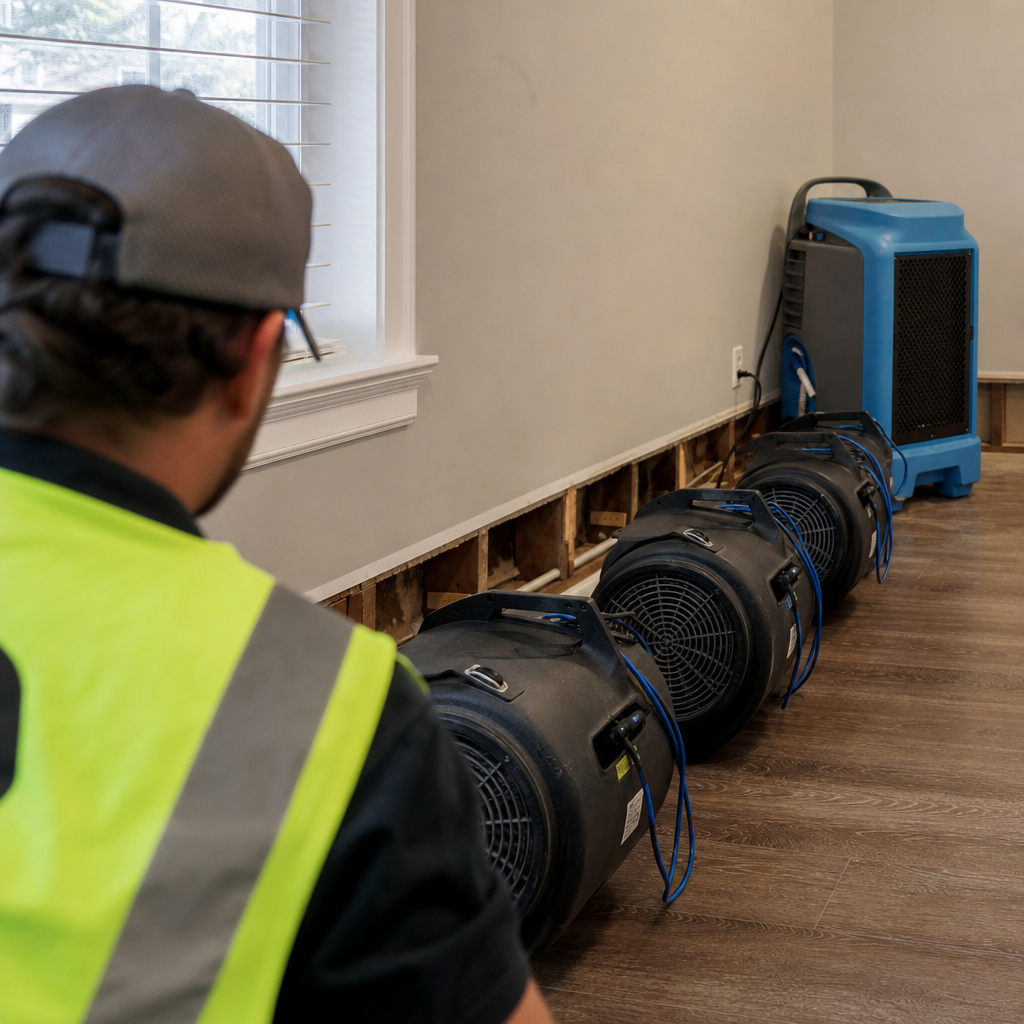
Proper water mitigation requires scientific moisture balance rather than superficial airflow. Blowing warm air over wet surfaces without pulling ambient humidity down creates a “secondary damage chamber,” warping hardwood, swelling doors, and rotting structural joists.
Drywall, Ceilings, and Subflooring: Repair vs. Replace Decisions
Industry standards and material science dictate whether assemblies can be saved in place or need clean removal:
| Material Type | Saturation Level | Action Required |
|---|---|---|
| Standard Drywall & Fiberglass Insulation | Wicked moisture above 2 inches or contaminated water | Make clean flood cuts 12 to 24 inches above moisture line; discard wet insulation |
| Hardwood & Plywood Subfloors | Elevated moisture content, no delamination | Apply specialized floor mat drying systems and heavy dehumidification; dry in place |
| Rubble-Stone Foundations & Brick Masonry | Deep moisture absorption from ground or sewer backup | Low-grain refrigerant dehumidification, negative air scrubbers, deep structural tracking |
Preventing Capillary Moisture and Secondary Damage
In older urban properties, water travels upward through foundation stone and plaster via capillary suction. When generic drying is applied without mapping these moisture trails, the surface can appear dry while interior masonry remains saturated. Our team uses non-invasive thermal imaging and penetrating probe meters to verify that deep structural framing and stone work reach dry baseline standards before walls are closed.
The 4-Step Structural Mitigation and Restoration Process
Need emergency water damage restoration?
We’re available now - call for a fast, free estimate.
From the moment our emergency vehicles arrive on scene, we follow a four-phase protocol designed to stabilize the building, reduce health risks, and restore your space efficiently.
-
Step 1: Emergency Water Extraction and Hazard Containment
Using truck-mounted extraction units and submersible pumps, our technicians extract standing water from basements, carpets, and concrete slabs. We set up containment barriers to prevent cross-contamination into unaffected rooms.
-
Step 2: Moisture Mapping and Structural Drying
Technicians map moisture boundaries behind walls, under tiles, and inside crawl spaces using infrared cameras and pinless meters. We place industrial low-grain refrigerant (LGR) dehumidifiers and high-velocity air movers to extract trapped water from the air and framing materials.
-
Step 3: Cleaning, Sanitization, and Mold Prevention
All exposed surfaces are treated with EPA-registered botanical and hospital-grade antimicrobial solutions. HEPA air scrubbers run continuously to capture airborne spores, dust, and particulate matter, helping protect indoor air quality.
-
Step 4: Reconstruction and Final Assessment
Once moisture logs confirm building materials have returned to dry standards, our reconstruction team handles drywall replacement, trim work, flooring, and paint. Managing the entire scope under one roof eliminates scheduling gaps and ensures direct accountability from start to finish.
How to Choose a Local Water Mitigation Company vs. National Chains
When dealing with a property emergency, property owners often face a choice between local, owner-operated specialists and large national franchise networks. Response models, crew consistency, and accountability can vary significantly between providers.
| Feature | Wade’s Restoration | National Franchise Chains | Independent Handymen |
|---|---|---|---|
| Emergency Dispatch | Fast 24/7 local dispatch (times vary by location) | Centralized dispatch or call-center routing | Varies by individual schedule |
| Technician Qualifications | Trained, background-checked local staff | Varies by franchise territory | Varies by contractor |
| Moisture Verification | Thermal imaging and logged psychrometric data | Standard moisture meters and logs | Often visual inspection only |
| Accountability & Warranty | Direct owner oversight and 90-Day Done Right Promise | Standard corporate dispute processes | Varies by contractor |
Direct Communication and Local Accountability
During severe weather outbreaks or deep winter freezes, centralized call centers can become backlogged, leading to delayed responses. Homeowners may experience incomplete drying or issues with insurance paperwork if mitigation is not carefully managed. Working directly with an owner-operated local company provides dedicated technicians who manage your property restoration directly.
Owner Accountability and Verified Drying Standards
Wade’s Restoration backs every job with direct owner oversight and our 90-Day Done Right Promise. We never remove drying equipment until meters confirm that framing studs, subfloors, and plaster meet structural baseline standards, protecting both your property value and your peace of mind.
Frequently Asked Questions About Emergency Water Damage Restoration
When unexpected water intrusion occurs, fast answers help you make informed decisions before secondary damage escalates. Here are direct answers to common questions our team receives during emergency calls.
How much does emergency water damage restoration cost?
Emergency water damage restoration costs generally range from roughly $450 to $16,000, with typical jobs often averaging in the low thousands. Smaller localized cleanups fall toward the lower end, while major sewage backups or multi-floor structural flooding can reach the higher end of the range. Exact costs depend on the volume of water, the category of contamination, and whether building materials require replacement. We provide clear, itemized scopes before work begins.[1]
How fast can an emergency restoration crew reach my property?
Wade’s Restoration provides fast 24/7 emergency response across Harrison, Kearny, Jersey City, Hoboken, and surrounding towns, with response times varying by location. Getting pumps and extraction equipment running promptly reduces water penetration into framing and subflooring.
Will homeowners insurance cover flood damage and burst pipes?
Standard homeowners policies generally cover sudden, accidental water discharges, such as a frozen pipe rupture, failed supply line, or malfunctioning water heater. Damage resulting from outdoor storm surges or rising rivers requires a separate flood insurance policy through the NFIP or a private flood carrier. Our team provides photographic documentation and moisture logs directly to your insurance company to support your claim.
What steps should I take immediately while waiting for the restoration crew?
First, turn off your main water valve to stop active flooding. Next, switch off power to affected rooms from your main breaker panel if it is safe to access. Move light furniture, rugs, and valuable electronics out of the water path, and avoid running standard household fans that can drive moisture into wall cavities.
How long does the water mitigation and drying process take?
The duration of the structural drying process depends on the volume of water, how long it sat, and the types of materials affected. Dense materials such as hardwood flooring, concrete subfloors, and masonry typically require more drying time. Technicians monitor equipment and take daily meter readings until structural materials are fully stabilized.
How do restoration professionals prevent mold after major water damage?
Preventing mold requires a complete, multi-step drying process:
- Rapid bulk water extraction: Removing standing water quickly to eliminate the liquid reservoir.
- Targeted antimicrobial treatments: Applying EPA-registered antimicrobials to structural surfaces to inhibit microbial growth.
- Controlled structural dehumidification: Running industrial LGR dehumidifiers to lower relative humidity and extract moisture trapped inside building assemblies.
- HEPA air filtration: Operating commercial air scrubbers to capture airborne spores and maintain clean indoor air.
If you are facing a pipe break, basement flood, or commercial water emergency in North Jersey, contact Wade’s Restoration. Our 24/7 live dispatch team is ready to respond with professional extraction and complete structural restoration.
Need emergency water damage restoration?
We’re available now - call for a fast, free estimate.
Sources
- Billion-Dollar Weather and Climate Disasters | United States Summary – ncei.noaa.gov (2024)
- Flooding Costs the U.S. Between $179.8 and $496.0 Billion … – jec.senate.gov (2024)
- 2023: A historic year of U.S. billion-dollar weather and climate … – climate.gov (2023)
- Water Damage Insurance Claims Statistics (2026) | ConsumerAffairs® – consumeraffairs.com (2026)
Related reading: Commercial Water Damage Restoration | Call Now-10% Off | Same-Day Service | Free Estimate
Related reading: Flood Restoration Near Me | 10% Off & Free Estimate | Same-Day Service
Related reading: Water Damage Restoration Service – Call Now-10% Off – Same-Day Service – Free Estimate
Frequently Asked Questions
How does Wade's Restoration detect and eliminate hidden moisture inside historic brick and stone foundations?
In older North Jersey properties, masonry and rubble-stone foundations can absorb water deep into mortar joints via capillary action without showing surface wetness. Wade's Restoration deploys non-invasive thermal imaging and penetrating probe meters to map trapped moisture, using low-grain refrigerant dehumidifiers to dry dense structural materials before walls are sealed.
Does Wade's Restoration handle structural repairs and reconstruction after water removal?
Yes, Wade's Restoration manages the complete recovery lifecycle under one roof, eliminating the need to hire separate rebuild contractors. Once structural framing meets verified dry baselines, our in-house reconstruction team restores drywall, baseboards, flooring, and finishes under our 90-Day Done Right Promise.
How does Wade's Restoration assist property owners with water damage insurance claims?
Our technicians compile real-time psychrometric drying logs, equipment run-time records, and photographic moisture mapping from the initial visual inspection onward. Wade's Restoration submits this comprehensive documentation directly to your insurance adjuster to justify covered mitigation steps and speed up claim processing.
About the author
 |
Sarah Higgins Sarah is a seasoned restoration specialist with over eight years of experience managing complex property recovery projects. Holding a B.S. in Construction Management from Rutgers University, she combines technical expertise with a compassionate approach to guide homeowners through stressful emergencies. Her writing focuses on practical advice for water damage mitigation, mold remediation, and navigating the insurance claims process. |
Water damage, flood, or mold emergency?
We’re available now - call for a fast, free estimate.
Call Now - Free Estimate