
Quick Summary
Trapped moisture behind wall assemblies frequently triggers structural deterioration and indoor air quality issues without showing obvious surface stains. Wade's Restoration highlights that subtle indicators like musty odors, peeling finishes, and rusted fasteners require precision diagnostic tools like thermal imaging and moisture meters rather than ineffective surface cleaning. Readers will learn how to recognize early signs of mold behind drywall and can schedule a professional moisture assessment to safely evaluate concealed wall cavities.
Possible Signs of Mold Behind Drywall
You do not need to see dark spots on a wall to have a moisture or mold problem. In many properties, moisture can accumulate on the paper backing of gypsum board, structural framing, and cavity insulation. The World Health Organization estimates that dampness affects between 10% and 50% of indoor spaces across North America, Europe, and other industrialized regions. When moisture gets trapped behind walls, it can create an environment that supports microbial growth. However, visible signs and physical symptoms alone do not confirm mold.[1]
Identifying hidden moisture issues early requires looking beyond obvious surface stains. By watching for water stains, damaged finishes, condensation, and distinct odors, you can identify wall cavity moisture issues before extensive damage occurs.
Quick Overview: Signs of Mold Behind Drywall at a Glance
Key potential signs of moisture or mold inside wall cavities: Persistent musty odors, bubbling or peeling paint, soft or deteriorated drywall, water stains, and discoloration along floor trim. Signs alone do not confirm mold. Wet, non-moldy materials should be dried within 48 hours to help prevent mold growth.[4]
Catching these indicators early helps address moisture sources before building materials suffer extensive deterioration.
Indicators of Possible Cavity Moisture
- Musty odors with clean wall surfaces: Damp, earthy smells near electrical outlets, baseboard trim, or switch plates may indicate hidden moisture or possible mold inside the cavity, though odors alone do not confirm mold.
- Fastener corrosion and damaged finishes: Rusted drywall screws, water staining, and peeling finishes point to dampness or liquid moisture inside or behind the wall.
- Respiratory and allergic symptoms: Damp indoor environments are associated with respiratory symptoms, respiratory infections, worsening or new-onset asthma, allergic rhinitis, and eczema, with individual effects varying by exposure and susceptibility.
Why Trapped Cavity Moisture Demands Prompt Action
Wet, non-moldy materials should be dried within 48 hours to help prevent mold growth. As noted by Wade’s Restoration, professional diagnostic tools, such as moisture meters and thermal imaging cameras, can help locate abnormal moisture or temperature patterns so damp areas can be addressed promptly.
Diagnostic Tools for Locating Hidden Moisture
Different tools help identify areas of dampness within wall assemblies. These tools help locate abnormal moisture or temperature patterns, but they do not independently confirm mold.[2]
| Diagnostic Method | Moisture Meter | Infrared Thermal Imaging | Borescope Inspection |
|---|---|---|---|
| Impact | Non-destructive | Non-destructive | Access hole required |
| Thermal Pattern Detection | No | Yes | No |
| Moisture and Cavity Assessment | Helps locate abnormal moisture patterns | Maps relative temperature patterns | Visual inspection of cavity |
| Primary Use | Checking gypsum and framing moisture | Locating abnormal temperature patterns | Inspecting for visible moisture or damage |
1. Persistent Earthy Odors and Musty Smells Near Baseboards
What does dampness or mold behind drywall smell like? It often produces an earthy, musty odor compared to rotting leaves, wet cardboard, or damp soil.
Because wall cavities are rarely airtight, odors can escape into living areas through gaps around electrical outlets, baseboards, and vents. If you notice a persistent musty smell in a room where visible surfaces are clean, the odor may indicate hidden moisture or possible mold trapped inside the wall or under flooring, though odor alone does not confirm mold.
2. Peeling Paint, Bubbling Wallpaper, and Surface Warping
Need signs of mold behind drywall?
We’re available now - call for a fast, free estimate.
When moisture enters a drywall panel from a plumbing leak, roof failure, or exterior seepage, it can affect surface finishes.
Trapped moisture can result in:
- Bubbling, blistering, or peeling paint.
- Peeling wallpaper seams where adhesives have deteriorated.
- Wavy, rippled, or bowed drywall surfaces caused by moisture intrusion.
3. Fastener Rust and Popping Screws
One indicator of hidden moisture is fastener degradation.
Drywall fasteners can oxidize when exposed to sustained dampness inside a wall cavity. Moisture-related movement in framing and drywall can also cause fastener heads to pop through the finished paint. Finding rust on popped screw heads indicates that the cavity behind the drywall has been exposed to dampness or liquid water.
4. Soft or Deteriorated Drywall
When exposed to liquid water or persistent dampness, drywall can soften and lose structural integrity. Drywall that feels spongy or yields when pressed indicates water damage.
In ceilings and upper walls, softening may cause visible sagging between framing members. Depending on the extent and condition of the water intrusion, damaged or mold-affected drywall may require removal and replacement. Relative humidity above 65% can promote microorganism growth, and moisture control is a primary way to reduce mold risk.
5. Damp Insulation Trapped in Wall Cavities
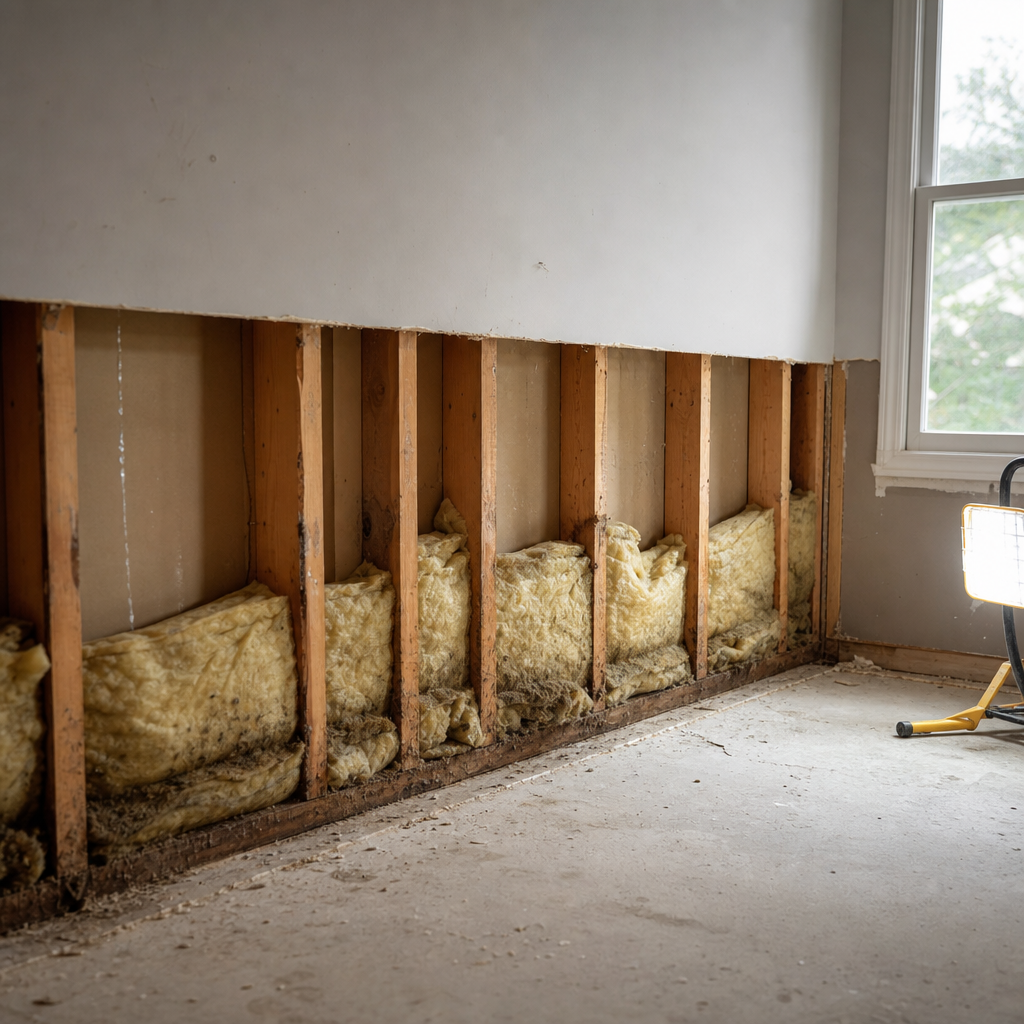
When moisture enters a wall cavity, insulation can become saturated and lose its insulating effectiveness. Trapped moisture keeps adjacent framing and drywall wet for extended periods, increasing the risk of material deterioration and fungal growth.
6. Cold Spots and Condensation
Temperature differences across exterior wall assemblies can lead to condensation inside wall cavities. According to Wade’s Restoration, using an infrared thermal camera allows specialists to locate abnormal temperature patterns that may be associated with trapped moisture, though thermal imaging cannot independently confirm mold.
7. Dark Staining Along Trim and Subfloors
Need signs of mold behind drywall?
We’re available now - call for a fast, free estimate.
Water from leaks or flooding tends to travel downward through framing bays. As moisture reaches the base of the wall, it can spread into baseboards and subflooring.
Persistent water stains, dark discoloration on baseboards, or stained flooring adjacent to a wall are indicators of damp areas or a history of leaks.
8. Health Symptoms and Damp Indoor Environments
Damp indoor environments are associated with respiratory symptoms, respiratory infections, worsening or new-onset asthma, allergic rhinitis, and eczema. Individual effects vary depending on the level of exposure and personal susceptibility.[3]
Epidemiological research cited by public health agencies links damp indoor environments to upper respiratory symptoms, coughing, and wheezing. If occupants experience persistent respiratory symptoms, an inspection for indoor moisture and possible mold is recommended.
How Professionals Locate Moisture and Hidden Growth
Trained technicians use structured, non-destructive tools to help locate abnormal moisture or temperature patterns, though these tools alone do not independently confirm mold:
- Thermal Imaging: Infrared cameras detect temperature differentials that help locate abnormal temperature patterns and wet building materials.
- Moisture Meters: Pin and pinless meters measure relative moisture levels in building materials to help locate abnormal moisture patterns.
- Cavity Air and Surface Sampling: Technicians can collect air or surface samples from inside the wall cavity for laboratory analysis.
- Borescope Visual Inspection: A small camera inserted through a small opening allows visual inspection of cavity framing and surfaces.
Other diagnostic methods, such as ground-penetrating radar, can also detect moisture anomalies, but radar cannot reliably distinguish mold from moisture alone.
Addressing Hidden Drywall Moisture and Mold
While minor surface mildew on non-porous surfaces can often be cleaned with standard household methods, concealed moisture inside wall cavities requires careful evaluation under the following conditions:
- Contaminated Water Sources: Water intrusion resulting from sewage backups, storm flooding, or contaminated drain lines introduces pathogens that require professional remediation.
- Extensive Water Damage: Significant leaks or chronic dampness affecting large sections of wall assemblies require comprehensive drying and moisture source repair.
- Compromised Occupants: Environments occupied by individuals with asthma, severe allergies, or compromised immune systems warrant prompt professional assessment.
- Material Degradation: Damaged or mold-affected drywall may require removal and replacement depending on the extent and condition of the materials.
Frequently Asked Questions About Mold Behind Drywall
What does mold behind drywall smell like?
It produces a stale, earthy, or musty odor similar to decaying wood, damp soil, or wet cardboard. Persistent musty odors may indicate hidden moisture or possible mold, but odors alone do not confirm mold.
How can you tell if there is mold inside a wall without tearing it down?
Professionals use tools such as infrared thermal imaging, moisture meters, and borescopes to help locate abnormal moisture or temperature patterns and visually inspect cavities. However, these tools and physical signs alone do not independently confirm mold, and methods such as radar cannot reliably distinguish mold from moisture alone.
What physical signs on drywall indicate possible hidden moisture or mold?
Supported indicators include persistent musty odors, water stains or discoloration, peeling or damaged finishes, condensation, damp areas, a history of leaks or flooding, and deteriorated or spongy drywall.[5]
How quickly should wet materials be dried after a leak?
Wet, non-moldy materials should be dried within 48 hours to help prevent mold growth.
What relative humidity level prevents mold growth behind walls?
Relative humidity above 65% can promote microorganism growth, and moisture control is a primary way to reduce mold risk.
Need signs of mold behind drywall?
We’re available now - call for a fast, free estimate.
Sources
- Is Mold Toxicity Really a Problem for Our Patients? Part I … – PMC – pmc.ncbi.nlm.nih.gov (2009)
- [PDF] Indoor dampness and mould health effects – CDC Stacks – stacks.cdc.gov (2007)
- Indoor dampness and mould health effects – PMC – NIH – pmc.ncbi.nlm.nih.gov (2011)
- NIOSH Health Hazard Evaluation Report 2022-0077-3422 – cdc.gov (2022)
- [PDF] California Department of Public Health – City of Santa Clara – santaclaraca.gov
Related reading: Commercial Water Damage Restoration | Call Now-10% Off | Same-Day Service | Free Estimate
Related reading: Flood Restoration Near Me | 10% Off & Free Estimate | Same-Day Service
Related reading: Water Damage Restoration Service – Call Now-10% Off – Same-Day Service – Free Estimate
Frequently Asked Questions
Can surface cleaning or bleach eliminate mold growing behind drywall?
Surface cleaning and household bleach cannot reach through porous gypsum to treat mold colonies thriving on the paper backing, cavity insulation, or framing. Wade's Restoration emphasizes that concealed microbial growth requires precision moisture diagnostics and controlled material removal rather than topical surface treatments.
How do specialists verify hidden mold inside a wall without tearing it down?
Technicians use non-invasive tools like thermal imaging and moisture meters to pinpoint damp areas, followed by minimally invasive wall-cavity air testing or borescope cameras through tiny access holes. This targeted approach allows Wade's Restoration to confirm hidden mold and map moisture boundaries without unnecessary wall demolition.
What should you do immediately if you notice signs of mold behind your walls?
Avoid cutting into the drywall yourself, as opening untreated wall cavities can disperse millions of mold spores and contaminants into your living areas. You should schedule a professional moisture assessment and visual inspection with Wade's Restoration to safely isolate the moisture source under proper containment.
About the author
 |
Sarah Higgins Sarah is a seasoned restoration specialist with over eight years of experience managing complex property recovery projects. Holding a B.S. in Construction Management from Rutgers University, she combines technical expertise with a compassionate approach to guide homeowners through stressful emergencies. Her writing focuses on practical advice for water damage mitigation, mold remediation, and navigating the insurance claims process. |
Water damage, flood, or mold emergency?
We’re available now - call for a fast, free estimate.
Call Now - Free Estimate