
Quick Summary
Securing fast approval for water damage insurance claims requires stopping water immediately and proving a sudden loss to prevent carrier delays or gradual wear-and-tear denials. Working with Wade's Restoration provides property owners with carrier-grade documentation, daily structural moisture logs, and direct adjuster coordination to justify every line item from emergency extraction to full rebuild. After reading, property owners will know the precise steps to document evidence, navigate deductible depreciation, and coordinate standardized scopes for maximum reimbursement.
Water Damage Insurance Claims: How to Get Paid Fast
Getting water damage insurance claims approved quickly and paid in full comes down to three things: stopping the water immediately, proving the loss was sudden, and giving your adjuster line-item documentation they can accept without dispute. According to data from the Insurance Information Institute (III), water damage and freezing rank among the most common property claims, consistently trailing only wind and hail in frequency. In 2023, water damage and freezing accounted for about 22.6% of homeowners insurance claims by frequency, with an average homeowners claim severity of $15,400.[1]
Despite how common these losses are, property owners often face delays or denials when carriers argue the damage was gradual, citing wear and tear or long-term foundation seepage. Proper documentation, including detailed moisture mapping and itemized estimates, helps establish the timeline of the loss and support the claim process.
Water Damage Insurance Claims: Fast Payout and Mitigation Summary
To secure a fast claim approval, report the damage immediately, stop the water source, and bring in a certified restorer such as Wade’s Restoration to log structural moisture levels before materials begin to dry on their own. Standard property insurance covers sudden and accidental water discharges, such as a burst pipe or an appliance supply line failure. It does not cover ground flooding, surface runoff, or long-term leaks.[2]
Key Filing Rules at a Glance
Insurance adjusters stall claims when property owners rely strictly on smartphone photos. Photos show surface discoloration, but they cannot prove the depth of water penetration or show when the water entered the wall cavity. To protect your claim:[3]
- Stop the Water and Mitigate Immediately: Your policy contains a strict duty to protect the property from further loss. Extract standing water right away to prevent mold growth and secondary structural rot.
- Address the Gradual Damage Issue: Insurers may investigate whether moisture in plaster or masonry is pre-existing. Consistent moisture tracking can provide documentation of an active drying curve to help show that the loss was sudden.
- Align the Mitigation and Rebuild Scopes: Keep your restoration records tied directly to your reconstruction estimates, ensuring all framing, insulation, and finish repairs are accounted for under one claim number.
What You Need Before Filing a Water Damage Claim
Gathering your paperwork before you dial your carrier’s first notice of loss hotline prevents misunderstandings that adjusters can use to deny coverage.
Policy Documents and Identification Details
Locate your declarations page to confirm your deductible, personal property limits, and structural coverage (Coverage A). Check whether your policy provides Replacement Cost Value (RCV) or Actual Cash Value (ACV), and verify if you have specific endorsements for water backup or sump pump failure.
Initial Loss Evidence Checklist
Collect the following records before demolition begins:
- Plumbing Invoices: A written receipt from a licensed plumber stating the exact cause of the break (for example, “sudden split in second-floor copper pipe supply line”) establishes clear proof of a sudden event.
- Visual Evidence: Take wide-angle and close-up videos of standing water, water lines on baseboards, warped flooring, and damaged personal items before anything is moved or discarded.
- Moisture Baselines: Ensure your restoration team takes structural moisture readings in both affected and unaffected rooms during the initial inspection to establish clear drying baselines.
Step 1: Stop the Source and Initiate Emergency Water Damage Restoration
Need water damage insurance claims?
We’re available now - call for a fast, free estimate.
Your first move must always be stopping the water flow and calling an emergency mitigation team. Waiting for an adjuster to inspect the site before beginning water extraction violates the policy condition requiring you to prevent secondary damage.
Shutting Off Main Water Lines
Locate your main water shutoff valve immediately, typically near where the municipal supply enters the structure. If the leak is isolated to an appliance or toilet, use the local angle stop valve to cut the supply.
Preventing Contaminated Water Hazards
Clean water from a supply line quickly degrades into Category 2 (gray water) or Category 3 (black water) as it comes into contact with building materials, dirt, and subflooring. Emergency mitigation teams like Wade’s Restoration extract standing water and stabilize structural framing before mold can develop.
Step 2: Capture Moisture Data and Logs to Support the Claim
Tracking moisture readings throughout the drying process helps document that damage resulted from a sudden event rather than unmaintained leaks or rising groundwater.
Why Phone Photos Fall Short in Older Properties
In older brick buildings or structures with masonry foundations, adjusters may argue that damp plaster, rotted baseboards, or wet subfloors result from chronic moisture or seasonal humidity. Standard smartphone photos cannot dispute this argument alone because a picture only shows a wet surface without measuring moisture levels over time.
| Evidence Standard | Cell Phone Photos | Spot Moisture Pins | Daily Moisture Logs |
|---|---|---|---|
| Carrier Audit Acceptance | Low | Moderate | High |
| Humidity and Moisture Tracking | None | None | Documented Measurements |
| Gradual Damage Documentation | Ineffective | Partial | Supports Sudden Loss Timeline |
Documenting the Drying Timeline
Tracking daily moisture levels, ambient temperature, and relative humidity establishes a documented drying curve. This helps demonstrate that the structure was affected by a specific, sudden event and is returning toward dry standards.
Step 3: Report the Claim and Request Adjuster Assignment
Once the water source is shut off and emergency drying is underway, call your insurance carrier to open the claim. Prompt reporting prevents administrative delays and gets an adjuster assigned to your file quickly.
Calling the Carrier Claims Department
When you speak to the representative, follow these steps:
- Provide the date and time the incident occurred, and request your claim number immediately.
- Obtain the assigned field adjuster’s name, direct phone number, and email address.
- Notify the carrier that an emergency restoration contractor is already on site extracting water to mitigate the loss.
- Direct the insurer to send all scope inquiries directly to your restoration contractor.
What to Say and What Terms to Avoid
Be accurate and direct. Describe the incident as a “sudden and accidental pipe burst” or an “abrupt appliance line failure.” Avoid speculative phrases like “it might have been leaking inside the wall for a while” or “we noticed a soft spot a few weeks ago.” Adjusters are trained to flag words suggesting long-term deterioration, which can trigger an immediate claim denial.
Step 4: Mitigate Damaged Ceilings, Drywall, and Hardwood Subfloors
Proper mitigation protects structural assemblies and prevents unnecessary structural tear-outs, keeping drying costs contained and defensible under your policy limits.
Drywall and Ceilings: Moisture Pockets and Sagging Risks
Ceilings holding trapped water pose a collapse hazard. Technicians relieve pressure by draining water pockets, opening controlled inspection holes, and checking for moisture migration along joists without gutting undamaged drywall unnecessarily.
Hardwood, Laminate, and Subfloor Extraction
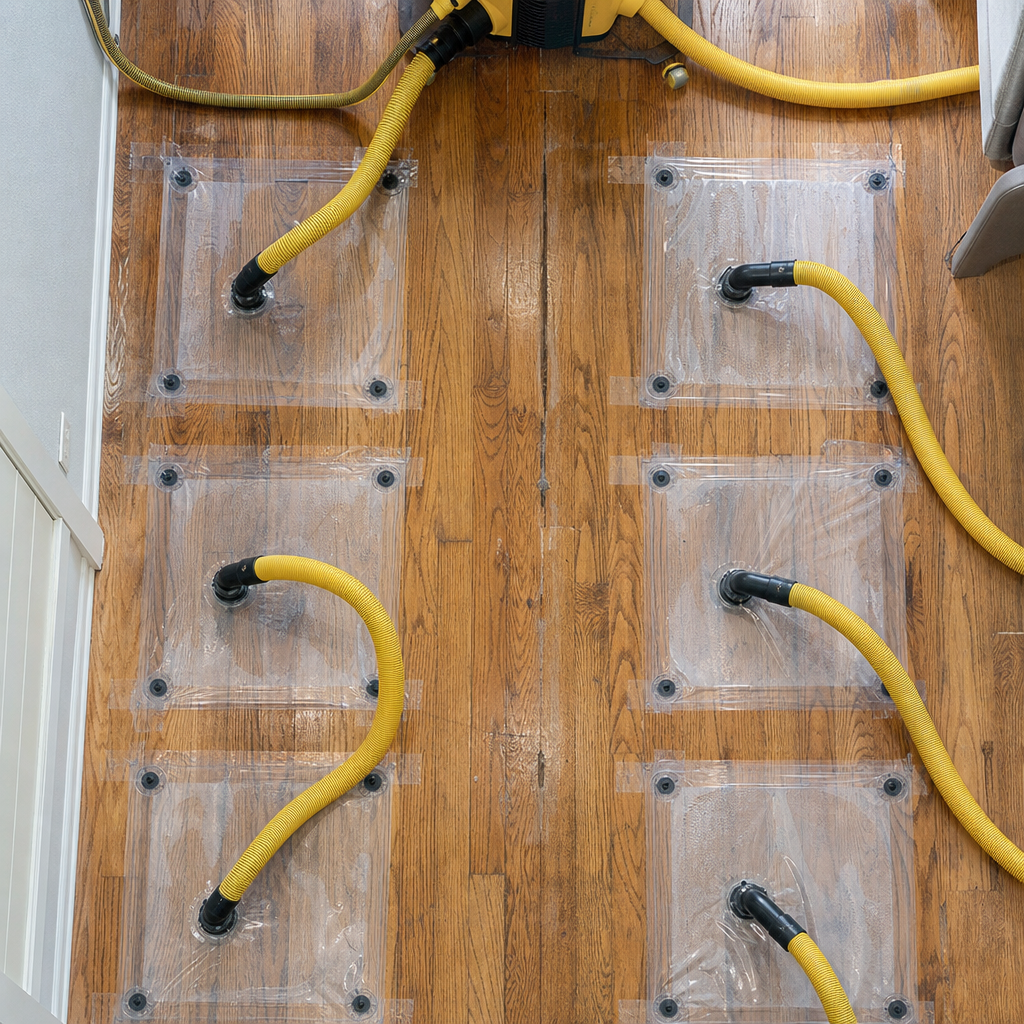
Water trapped under hardwood causes cupping, crowning, and subfloor delamination. Commercial drying systems used by professionals like Wade’s Restoration can draw moisture from materials under controlled conditions. Tracking moisture readings helps evaluate whether hardwood can be salvaged or requires replacement under your policy’s structural coverage.
Basement and Crawl Space Structural Drying
Masonry and brick foundations can wick water upward. Commercial dehumidifiers and air movers manage moisture in these spaces, helping protect structural components and prevent mold growth.
Step 5: Coordinate Adjuster Inspections with Standardized Estimates
Need water damage insurance claims?
We’re available now - call for a fast, free estimate.
To help ensure your claim reflects necessary repair costs, mitigation and reconstruction estimates should use standardized industry estimating formats.
Using Standardized Itemized Scopes
Many insurance carriers write their estimates using standardized software platforms that apply regional labor and material pricing. Writing estimates using itemized unit codes and supporting documentation helps reduce scope disputes and facilitate review.
Resolving Estimate Discrepancies and Scope Gaps
When the adjuster’s initial scope misses necessary repairs, do not accept the payout check as a final settlement. Take these actions:
- Compare the adjuster’s estimate line by line against your contractor’s moisture map to make sure every wet wall cavity and subfloor area is included.
- Submit a formal supplement containing daily drying logs and hidden-damage photos if wet insulation or structural framing is discovered during demolition.
Step 6: Complete Full Reconstruction Under a Single Insurance Scope
Hiring one contractor like Wade’s Restoration to manage both emergency cleanup and full rebuild can help reduce handoff delays and coordination issues between separate companies.
Transition from Mitigation to Rebuild
When mitigation and reconstruction are split between different vendors, adjusters may question responsibility for specific items, such as continuous floor underlayment or trim replacement. Managing recovery under a coordinated scope facilitates communication with the adjuster and helps ensure finishes, paint, and flooring align with pre-loss conditions.
Securing the Final Certificate of Completion
Do not sign a final Certificate of Completion until you have walked the property with your contractor. Verify that structural moisture content is back to baseline, there are no lingering odors, and all finishes are fully restored. Once signed, your carrier will release any held-back depreciation funds.
What Do Water Damage Insurance Claims Cost?
The total cost of a water damage claim depends on the category of water, the square footage affected, and the degree of structural reconstruction required. Once your claim is approved, your direct out-of-pocket obligation is typically limited to your policy deductible.
Typical Restoration and Claim Cost Ranges
While the average homeowners claim severity for water damage and freezing is approximately $15,400 according to III data, complex structural losses can run higher.
| Restoration Phase | Typical Cost Range |
|---|---|
| Emergency Water Extraction and Drying | $2,500 – $7,000 |
| Structural Demolition and Antimicrobial Treatment | $3,000 – $9,500 |
| Full Reconstruction (Drywall, Trim, Flooring, Paint) | $5,000 – $35,000+ |
How Deductibles and Depreciation Work
In most claims, the insurance company issues an initial payment based on Actual Cash Value (ACV), which subtracts depreciation based on the age of materials. After repairs are completed and final documentation is submitted, the carrier releases the withheld depreciation (Recoverable Depreciation) under Replacement Cost Value (RCV) policies.
Frequently Asked Questions About Water Damage Insurance Claims
Does homeowners insurance cover sudden water damage?
Yes. Standard homeowners insurance policies cover sudden and accidental water discharges, such as frozen and burst pipes, water heater ruptures, and washing machine supply line failures. They do not cover rising floodwaters, surface runoff, or continuous, unresolved leaks.
Should I call an emergency restoration company or insurance first?
Call an emergency restoration company first to shut off the water and extract standing moisture. Policy conditions require you to protect your property from ongoing damage immediately. Once crews are dispatched, contact your insurer to report the loss and obtain a claim number.
What water damage scenarios are typically excluded or denied?
Claims are routinely denied for flood damage from overflowing rivers or surface runoff (which requires separate flood insurance), sewer backups (unless you have a specific endorsement), and gradual damage caused by ongoing leaks that were neglected over time.
How much does water damage restoration cost?
Emergency mitigation and drying typically ranges from $2,500 to $9,000, while full reconstruction can exceed $20,000 depending on materials and structural damage. For covered claims, your primary out-of-pocket cost is your deductible.
How long does an insurance company take to pay out a water damage claim?
Payment timelines vary based on the carrier, claim complexity, documentation submitted, and required inspections. Initial mitigation payments and reconstruction disbursements are subject to policy terms and adjuster approval.
How do restoration contractors work directly with insurance adjusters?
Restoration contractors like Wade’s Restoration provide adjusters with itemized estimates, moisture logs, and photographic evidence. By utilizing standardized documentation and pricing formats, contractors help clarify scope details and resolve estimate differences directly.
Need water damage insurance claims?
We’re available now - call for a fast, free estimate.
Sources
- Roof Leak Insurance Claims (2026): Frequency & Cost – theroofingbrief.com (2026)
- Water Damage Insurance Claims Statistics (2026) | ConsumerAffairs® – consumeraffairs.com (2026)
- Water Damage Statistics and Information – This Old House – thisoldhouse.com (2025)
Related reading: Commercial Water Damage Restoration | Call Now-10% Off | Same-Day Service | Free Estimate
Related reading: Flood Restoration Near Me | 10% Off & Free Estimate | Same-Day Service
Related reading: Water Damage Restoration Service – Call Now-10% Off – Same-Day Service – Free Estimate
Frequently Asked Questions
What should I do if my insurance adjuster's payout estimate is lower than the actual repair costs?
If an adjuster's estimate is too low, do not accept the initial check as a final settlement. Wade's Restoration resolves scope gaps by submitting itemized supplements with carrier-grade photo logs and moisture maps directly to your adjuster to secure full funding.
How do I prove water damage was sudden and accidental to prevent a claim denial?
Carriers look for proof that moisture was not caused by long-term neglect, which requires documented drying baselines and diagnostic plumber reports. Wade's Restoration captures daily structural moisture logs and psychrometric data from day one to establish an active drying timeline that validates sudden loss.
How do I collect the withheld recoverable depreciation on my water damage claim?
Insurers withhold depreciation until all mitigation and structural rebuild work is fully completed under your Replacement Cost Value (RCV) policy. Wade's Restoration streamlines this process through end-to-end reconstruction management, submitting the final Certificate of Completion and itemized invoices to trigger the prompt release of your holdback funds.
About the author
 |
David Wallace David Wallace is a property restoration specialist with a background in construction management from Rutgers University. With over a decade of experience coordinating complex commercial and residential rebuilds in New Jersey, he specializes in storm damage recovery and navigating the insurance claims process. David provides actionable guidance to help property owners secure their premises and streamline their restoration projects. |
Water damage, flood, or mold emergency?
We’re available now - call for a fast, free estimate.
Call Now - Free Estimate