
Quick Summary
Navigating sudden property damage requires specialized insurance restoration contractors who can simultaneously execute emergency physical mitigation and provide carrier-grade claim documentation. Wade's Restoration provides a premier single-source solution by unifying 24/7 emergency water extraction, objective moisture mapping, direct adjuster navigation, and complete structural reconstruction under one team. Property owners will understand every phase of the claim and rebuild process and can immediately schedule a free visual inspection or contact the 24/7 live dispatch team for rapid emergency recovery.
Insurance Restoration Contractors: Fast Claims & Full Repair
When pipes burst, rivers rise, or storm winds rip open a roof, the clock starts ticking immediately. Property owners are forced to juggle two emergencies at once: stopping physical destruction and navigating an insurance claim. Specialized insurance restoration contractors step in to handle both sides of that crisis. They specialize in sudden property damage repair, document damage for carrier reviews, and rebuild the property back to pre-loss condition.[1]
According to an industry estimate reported by Qualified Remodeler, the restoration sector is projected to top $4 billion in 2025. Recovering from severe property damage requires direct alignment between mitigation crews, rebuild carpenters, and adjusters. At Wade’s Restoration, we help coordinate cleanup and reconstruction. Our IICRC-certified teams serve Harrison, Kearny, Jersey City, Hoboken, and surrounding communities with 24/7 live dispatch, visual inspections, and claim support.
What You Should Expect from Insurance Restoration Contractors
Insurance restoration contractors are specialized property recovery builders. Unlike standard general contractors, they specialize in sudden property damage repair and are more claims-focused and documentation-heavy. They work directly with property owners and carriers to document why specific structural assemblies require removal, drying, or replacement.
Data from Qualified Remodeler shows that work volume in the restoration sector continues to expand, climbing from 314,704 total jobs to 372,296 in 2024. Hiring a dedicated restoration contractor helps ensure your property transitions from emergency water mitigation to final reconstruction with appropriate documentation throughout the process.[2]
Core Responsibilities and Response Standards
A dependable restoration company operates with specific emergency standards from the moment the dispatch call comes in:
- Immediate Site Stabilization: Prompt on-site arrival helps halt water migration and protect structural materials from further damage.
- Itemized Carrier Documentation: Crews compile photo logs, atmospheric readings, and moisture records to support claim reviews.
- Single-Source Reconstruction: Managing both drying and reconstruction under one team helps keep property recovery on schedule.
Key Differences Between General Builders and Restoration Specialists
While general contractors focus on planned renovations and standard construction, restoration contractors specialize in sudden property damage repair and are more claims-focused and documentation-heavy.
| Capability | Standard General Contractor | Restoration Specialist |
|---|---|---|
| Focus Area | Planned remodels and new construction | Sudden property damage recovery |
| Claim Documentation | Standard estimates | Claims-focused, documentation-heavy reporting |
| Emergency Response | Standard business hours | 24/7 live emergency dispatch |
| Project Continuity | General repair and rebuilding | Coordinated mitigation through final reconstruction |
What You Need Before Hiring an Insurance Restoration Contractor
Before signing a work authorization, gather your insurance policy declarations page, your deductible amount, the exact date and time the loss occurred, and your preliminary photos. Policyholders are generally not required to use the insurer’s preferred vendor and may choose an independent contractor to handle their repairs.
Essential Policy Details and Loss Information
- Declarations Page: Pinpoint your coverage limits, policy number, and the deductible amount.
- Loss Timeline: Record when the incident occurred and take photos before materials are moved or removed.
- Peril Distinction: Determine whether the loss involves sudden indoor plumbing discharge or rising overland water, which may involve different coverage terms.
Understanding the “Duty to Mitigate” and Contractor Options
Property insurance policies generally include a duty to mitigate, requiring policyholders to take reasonable steps to prevent further damage after a loss occurs. While insurers may offer preferred vendor networks, policyholders can also work with independent restoration specialists who focus on thorough property recovery.
Independent restoration contractors work directly for the property owner to assess structural drying needs thoroughly, ensuring moisture is properly addressed in framing, subfloors, and masonry before closing up walls.
Step 1: Secure Emergency Water Damage Restoration and Site Containment
Need insurance restoration contractors?
We’re available now - call for a fast, free estimate.
Fulfilling mitigation requirements begins with site containment. Professional restoration contractors arrive equipped to halt active water flow, address safety risks, and extract standing water before it causes further structural issues.
Protecting Basements and Foundations
Older homes throughout northern New Jersey often feature masonry or stone foundations that absorb standing water, requiring focused mitigation efforts:
- Isolate Electrical Hazards: Identify electrical risks in flooded areas and establish safe work zones.
- Water Extraction: Remove standing water promptly from basements and low points to minimize material saturation.
- Establish Containment Zones: Separate wet work areas from unaffected living spaces to help maintain indoor air quality.
Preventing Secondary Damage
Qualified Remodeler reports that insurance restoration accounts for roughly 75% of total jobs among dedicated restoration firms in 2025. That specialization is important because proper early mitigation and documentation help prevent ongoing property issues. Wade’s Restoration provides 24/7 live dispatch to arrive promptly on site, secure the area, and establish baseline moisture readings.[3]
Step 2: Document Structural Damage Across Drywall, Floors, and Ceilings
Successful insurance claims rely on clear, objective physical documentation. Restoration contractors map moisture levels across affected materials before major demolition begins.
Assessing Drywall and Ceiling Saturation
Water frequently migrates through wall cavities and along structural framing. Technicians use moisture meters and thermal imaging tools to identify hidden moisture pockets without unnecessary demolition, providing factual data to assist claim reviews.
Inspecting Subfloors, Joists, and Hardwood Integrity
Evaluating whether flooring and framing can be dried in place or require removal involves checking saturation levels across assemblies:
- Hardwood and Underlayment: Assess flooring and underlying subfloor layers for saturation and warping.
- Structural Framing: Take moisture readings in framing studs and joists to verify structural drying progress.
Restoration companies invest in customer communication and documentation standards. Qualified Remodeler notes that average marketing and customer support spending rose to 4.6% of gross revenue in 2024, up from 4.1% in 2023. This investment supports clear communication and thorough documentation for property owners and adjusters.
Step 3: Align Claim Scopes Directly with the Insurance Adjuster
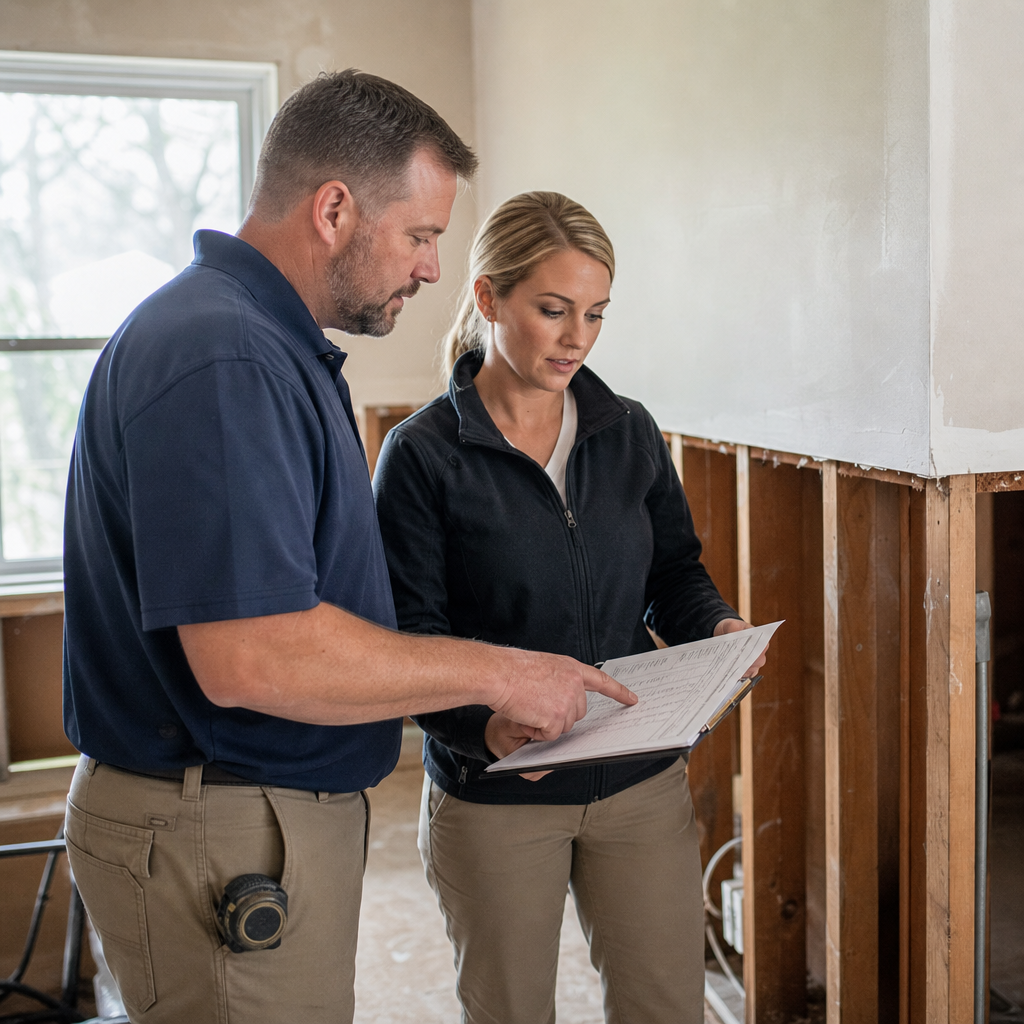
Once damage is documented, the contractor reviews the repair scope alongside the insurance adjuster. Having a restoration professional participate in inspections helps ensure that structural requirements, necessary code updates, and appropriate repairs are clearly communicated.
Navigating Adjuster On-Site Inspections
During walkthroughs, restoration contractors can provide moisture maps and documentation to show where moisture has traveled behind baseboards or inside exterior walls. Wade’s Restoration participates in site walkthroughs to review findings directly with adjusters.
Resolving Scope Questions
Restoration contractors provide line-item estimates and supporting moisture logs to help clarify project scopes. When local building codes require specific updates, the contractor provides relevant documentation directly to the carrier.
According to Qualified Remodeler, direct customer referrals account for 30% of top lead sources for established restoration contractors, with repeat business generating another 13.7% in 2025.[4]
Step 4: Execute Structural Drying and Site Remediation
Need insurance restoration contractors?
We’re available now - call for a fast, free estimate.
Physical drying involves managing airflow, temperature, and dehumidification to remove moisture from structural materials.
Dehumidification and Air Filtration
Restoration specialists deploy commercial equipment tailored to the needs of the space:
- Commercial Dehumidifiers: These units remove moisture from the air to facilitate drying in structural framing and subfloors.
- Air Scrubbers: Filtration equipment helps capture airborne dust and particles during demolition and drying.
- Targeted Treatments: When addressing contaminated water sources, appropriate cleaning and antimicrobial agents are applied to sanitize affected surfaces.
Thorough Drying Protocols
Proper drying requires keeping equipment in place until moisture readings confirm that materials have returned to acceptable dry standards. According to C&R Magazine, citing the Restoration Industry Association Cost of Doing Business Report, the average net profit margin for restoration companies is roughly 14%, with over half operating below 10% and 8% running at a loss. Independent restoration contractors, such as Wade’s Restoration, maintain drying equipment until moisture meters verify that structural materials are sufficiently dry.[5]
Step 5: Complete Full Reconstruction and Final Insurance Sign-Off
Once the structure is thoroughly dried and sanitized, reconstruction begins. Working with a contractor capable of managing both mitigation and rebuilding helps streamline the transition between phases.
Rebuilding Framing, Insulation, and Finish Carpentry
Reconstruction crews replace insulation, drywall, trim, and flooring to return the home to its pre-loss condition, taking care to match existing finishes and architectural details.
Final Walkthrough and Completion Documentation
Closing out a restoration claim involves several final steps:
- Property Owner Walkthrough: The property owner and contractor review the completed work to confirm satisfaction.
- Certificate of Completion: The contractor submits completion documentation, required waivers, and final photos.
- Claim Closeout: The final documentation package is submitted to the insurer for claim settlement.
Cleanfax notes in its 2025 Restoration Benchmarking Survey Report that industry data is based on contractor survey responses rather than audited financial statements. This underlines the value of working with contractors who provide clear, transparent documentation throughout the project.
How Are Insurance Restoration Projects Billed?
Payment methods for insurance restoration projects can vary. For covered insurance losses, some projects may use an approved Direction to Pay agreement, authorizing the insurance carrier to issue payments directly to the contractor as work milestones are reached. In other cases, payments may be issued to the property owner. Policyholders are typically responsible for their policy deductible and any optional upgrades or non-covered items they elect to include during reconstruction.
Frequently Asked Questions About Insurance Restoration Contractors
How does billing work for insurance restoration projects?
Billing procedures can vary by project and policy terms. Contractors provide documentation and estimates for covered claims, and some projects may use approved payment direction agreements with the carrier. Property owners are generally responsible for their insurance deductible.
Can I choose my own contractor for homeowners insurance repairs?
Yes. Policyholders are generally not required to use the insurer’s preferred vendor and have the option to select an independent, qualified contractor.
Do insurance restoration contractors work directly with insurance adjusters?
Yes. Restoration contractors coordinate with adjusters by providing moisture documentation, photo logs, and detailed estimates to assist with claim reviews.
What is the difference between a general contractor and an insurance restoration contractor?
While general contractors focus primarily on standard remodeling and new builds, insurance restoration contractors specialize in sudden property damage repair and are more claims-focused and documentation-heavy.
How does an insurance restoration contractor document claim estimates?
Contractors use industry estimating software, moisture logs, and visual documentation to support line items based on physical evidence and project requirements.
How quickly can an insurance restoration contractor respond to an emergency?
Wade’s Restoration provides 24/7 live dispatch to respond promptly across Hudson and Essex counties, helping secure the property and begin initial mitigation.
Need insurance restoration contractors?
We’re available now - call for a fast, free estimate.
Sources
- Insurance Restoration Industry Statistics: Market Data Report 2026 – gitnux.org (2030)
- Insurance Restoration Industry Statistics | 2026 Edition – worldmetrics.org (2026)
- Insurance Restoration Industry Statistics 2026 | Gaugius – gaugius.com (2026)
- 2025 Top 500 Insurance Restoration: Value in Service – qualifiedremodeler.com (2025)
- Inside the Cost of Doing Business Survey: What It Means … – randrmagonline.com (2024)
Related reading: Basement Flood Cleanup Cost – Call Now-10% Off – Same-Day Service – Free Estimate
Frequently Asked Questions
What happens if an insurance adjuster's initial payout estimate is lower than the actual repair costs?
If an adjuster's preliminary estimate omits hidden damage or mandatory local code upgrades, your restoration team submits a formal claim supplement backed by photographic evidence and moisture logs. Wade's Restoration works directly with adjusters during on-site inspections to resolve scope discrepancies and secure necessary coverage adjustments before reconstruction starts.
Can I make elective home upgrades or layout changes during the structural rebuild phase?
Yes, property owners can integrate layout changes, premium finishes, or modern material upgrades while reconstruction crews are already rebuilding damaged areas. Wade's Restoration coordinates both projects simultaneously, clearly separating covered insurance repairs from elective, out-of-pocket upgrades on itemized documentation.
How long does the structural drying process take before rebuilding can begin?
Industrial structural drying typically requires three to five days depending on the saturation depth, foundation materials, and room air volume. Wade's Restoration deploys commercial dehumidifiers and maintains continuous moisture tracking, verifying that framing and subflooring reach verified dry standards before any drywall or flooring installation begins.
About the author
 |
David Wallace David Wallace is a property restoration specialist with a background in construction management from Rutgers University. With over a decade of experience coordinating complex commercial and residential rebuilds in New Jersey, he specializes in storm damage recovery and navigating the insurance claims process. David provides actionable guidance to help property owners secure their premises and streamline their restoration projects. |
Water damage, flood, or mold emergency?
We’re available now - call for a fast, free estimate.
Call Now - Free Estimate