
Quick Summary
Swift professional intervention within 24 to 48 hours of flooding is critical to prevent deep masonry moisture migration, structural rot, and rapid secondary mold proliferation. Wade's Restoration provides end-to-end restoration services for water damage, deploying industrial extraction, technical dehumidification, and complete reconstruction to protect historic and modern building materials. Property owners will understand key salvage protocols for saturated assemblies and can call Wade's Restoration 24/7 for immediate emergency dispatch and a free visual inspection.
Restoration Services Water Damage – Stop Mold & Rebuild Fast
When clean water from a ruptured supply line or dirty floodwater enters your property, speed determines whether you face a straightforward drying job or months of structural repairs. Wade’s Restoration delivers prompt, hands-on restoration services for water damage across Harrison, Kearny, Jersey City, and Hoboken. Our certified technicians handle the entire recovery cycle, from high-capacity extraction and technical drying to complete structural rebuilding, providing clear moisture records so your insurance carrier pays what is owed.
If you have standing water or damp wall cavities, call Wade’s Restoration 24/7 for immediate dispatch and a thorough on-site inspection.
Emergency Water Damage Restoration: What to Expect and How Fast to Act
Emergency Water Damage Restoration in brief: Professional mitigation starts with immediate water extraction, detailed thermal moisture mapping, and containment. Within 24 to 48 hours of saturation, organic building materials begin harboring microbial growth, while masonry and timber draw moisture deep into structural cores. Immediate intervention stops capillary wicking, protects indoor air quality, and preserves your insurance coverage.
When our crews arrive on site, we immediately identify the water source, classify the contamination level (Category 1 clean water, Category 2 gray water, or Category 3 black water), and set up physical containment. Emergency mitigation is not just about vacuuming up visible water. It requires balancing airflow, ambient temperature, and specific humidity to draw bound water out of structural assemblies before framing warps or subfloors delaminate.
Key Takeaways for Property Owners Facing Active Flooding
According to the Insurance Information Institute, about 1 in 60 insured homes files a water damage or freezing claim each year. Plumbing failures, failed water heaters, and storm surges represent a major percentage of these property losses. For owners of historic row homes and multi-unit buildings near the Passaic riverfront, standard drying techniques often fall short. Unmonitored drying leaves moisture trapped in thick brick walls and rubble-stone foundations, leading to hidden rot and costly future repairs.
The Critical 24 to 48-Hour Mitigation Window
Time is the main factor governing restoration scope. During the first day, clean water spreads across subfloors and wicks up drywall. Between 24 and 48 hours, trapped humidity turns dormant mold spores into active colonies, while drywall core gypsum begins to crumble. After 24 to 48 hours, the risk of mold growth increases substantially and secondary damage worsens, dramatically increasing extraction and repair costs.
What Does Restoration Services Water Damage Cost?
Need restoration services water damage?
We’re available now - call for a fast, free estimate.
Total restoration costs depend on square footage, water category, how long materials remained submerged, and the extent of demolition or reconstruction required.
Standard Scope by Restoration Service Category
| Restoration Service Category | Typical Scope of Work |
|---|---|
| Inspection & Moisture Mapping | Thermal imaging, non-penetrating meters, deep probe hygrometer readings |
| Emergency Water Extraction | Truck-mounted vacuum units, submersible pumps, weighted subfloor extractors |
| Industrial Structural Drying | Low-grain refrigerant (LGR) dehumidifiers, cavity air injection |
| Mold Remediation & Sanitization | HEPA air scrubbing, anti-microbial treatments, containment |
| Reconstruction & Build-Back | Drywall hang and tape, joist repair, subfloor replacement, trim carpentry |
Key Factors That Drive Overall Water Loss Expenses
Historic and pre-war architecture introduces distinct financial risks during a water loss. Plaster walls, heart-pine subflooring, and masonry foundations absorb massive volumes of water. FEMA and the National Flood Insurance Program note that just one inch of floodwater in a typical home can cause more than $25,000 in direct damages. Fast extraction and specialized drying equipment keep your overall repair bill substantially lower by preserving original materials whenever possible.[1]
Navigating Insurance Claims and Carrier Documentation
Insurance carriers frequently dispute or underpay water claims when contractors fail to prove that drying met industry standards. Wade’s Restoration eliminates claim bottlenecks by supplying direct adjusters with complete documentation packages. We record daily psychrometric readings, thermal imaging records, and itemized scopes coded to standard industry estimating platforms, proving that every piece of drying equipment was technically necessary.
Drywall, Ceilings, and Plaster: Repair vs. Replace Criteria
Deciding whether to dry an interior wall in place or perform flood cuts comes down to the water classification, core structural stability, and depth of saturation. Standard drywall quickly loses its gypsum core strength when soaked, while historic lime plaster on wood lath can often be saved if the mechanical plaster keys behind the wall remain unbroken.
| Wall Assembly | Salvage Protocol (In-Place Drying) | Replacement Trigger (Demolition) |
|---|---|---|
| Standard Drywall | Category 1 water, intact gypsum core, and material dried to safe levels | Crumbly core, sagging boards, or Category 2 or 3 water requiring flood cuts |
| Historic Plaster | Keys intact, plaster firmly bonded to lath, no sagging or deflection | Broken plaster keys, ceiling deflection, structural framing rot behind the lath |
| Cavity Insulation | Closed-cell spray foam verified dry with moisture meters | Saturated fiberglass batts, loose blown-in cellulose, mineral wool |
Symptoms of Hidden Moisture Behind Finished Walls
Water wicks upward inside stud bays long after the floor appears dry. Even when latex surface paint looks clean, water often pools on bottom sill plates behind baseboards. If unaddressed, this hidden moisture rots wall studs and breeds mold inside the cavity. Industry data shows that the average insurance payout was $13,954 over 2018-2022, and a large share of that cost stems from hidden moisture that was missed during initial cleanup.
When Plaster and Drywall Can Be Saved vs. Cut Out
When drywall absorbs contaminated water or stays soaked for multiple days, our technicians execute precise flood cuts above the water line. This removes contaminated sheetrock and opens stud bays for direct airflow. On ceilings, sagging plaster signals broken mechanical keys, which creates a collapse hazard requiring controlled removal before structural drying begins.
Preventing Secondary Mold in Cavity Insulation
Wet fiberglass and cellulose insulation compacts, loses its thermal resistance, and traps moisture directly against wooden studs. We pull saturated insulation immediately, apply EPA-registered antimicrobials to bare framing, and direct air streams into the wall cavity to bring framing timbers back to safe baseline moisture levels.
Basement Flooding and Rubble-Stone Foundations: The Pre-War Moisture Trap
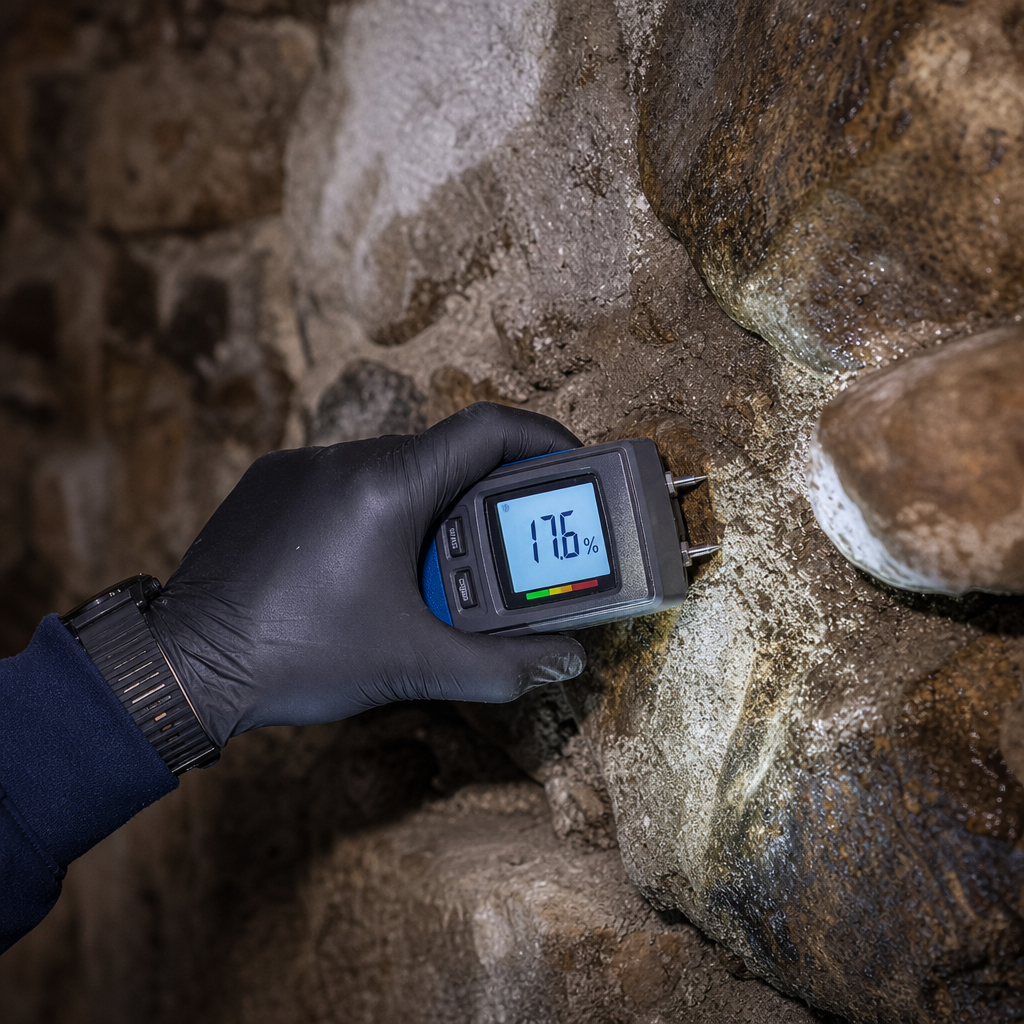
Basements across Harrison, Jersey City, and Hoboken often feature fieldstone, soft brick, or rubble-stone foundations bound with historic lime mortar. These materials absorb groundwater like a sponge. Applying high-velocity surface fans to these walls evaporates surface moisture quickly but creates negative pressure that pulls deep moisture outward, gradually turning lime mortar into loose, sandy powder.
Why High-Velocity Fans Fail in Historic Masonry
Standard axial fans dry only the immediate surface of dense foundation materials. This surface evaporation leaves the inner core of the stone or brick wet. Over months, this trapped moisture breaks down foundation strength and sends musty, spore-laden air upward into upper living spaces.
Capillary Moisture Migration in Brick and Fieldstone
In low-lying riverfront neighborhoods, hydraulic pressure forces water through masonry joints via capillary suction. When this moisture reaches finished basement wall assemblies, it rots base plates and studs from the back side. Proper restoration requires managing the vapor-pressure differential between the foundation wall and the basement air volume.
Deep Structural Dehumidification Protocols
Thoroughly drying dense masonry assemblies requires a controlled, three-step technical approach:
- Continuous Water Removal: Pumping standing water out rapidly to relieve hydrostatic pressure against foundation walls.
- Vapor-Pressure Control: Running commercial dehumidifiers to lower ambient humidity, which draws moisture out of masonry without shocking the lime mortar.
- Desiccant Cavity Drying: Deploying industrial desiccant dehumidifiers when deep stone saturation requires low dew points for complete moisture extraction.
Hardwood Floors and Subfloors: Salvage Protocols vs. Full Rebuild
Need restoration services water damage?
We’re available now - call for a fast, free estimate.
Whether solid wood flooring can be restored depends on water exposure time, the subfloor material, and how quickly extraction starts. Solid tongue-and-groove hardwood over pine subflooring can often be saved using negative-pressure drying systems. Conversely, wet OSB (oriented strand board) swells along the edges, delaminates, and usually requires replacement.
Cupping vs. Crowning: Diagnosing Wood Floor Saturation
Cupping occurs when board edges rise higher than their centers, indicating that the bottom of the wood or the subfloor is wetter than the surface. Crowning occurs when board centers bulge upward, usually because the surface was aggressively sanded or dried while the underlying subfloor remained soaked. Accurately diagnosing these conditions prevents premature sanding that permanently ruins hardwood.
Specialized Drying Systems vs. Tear-Out Decisions
| Subfloor Assembly | Salvage Criteria | Rebuild Trigger |
|---|---|---|
| Tongue-and-Groove Plank | Prompt extraction; boards remain structurally sound and properly bonded | Permanent joist twisting, subfloor rot, or black water saturation |
| Plywood Subfloor | Veneers remain bonded and material dries to safe baseline levels | Severe surface delamination, soft spots, or microbial growth between layers |
| Modern OSB Sheathing | Minimal edge swelling; structural glue bonds remain solid | Significant swelling, mushy core, or permanent buckling |
Protecting Joists and Subflooring from Deep Rot
To confirm that load-bearing wood is completely safe, we follow a strict verification protocol:
- Take baseline readings from dry, unaffected framing elsewhere in the building.
- Attach vacuum floor mats directly over cupped hardwood to extract bound water through the board joints.
- Monitor daily drying logs until structural subflooring and floor joists reach safe baseline moisture levels.
How to Choose a Restoration Contractor: Local Expert vs. National Franchise
Choosing the right contractor for water damage restoration means finding a team that combines rapid arrival times with technical accountability. National call centers frequently hand off emergency calls to third-party subcontractors who drop off a few blowers, submit an estimate, and leave without verifying deep structural drying.
Critical Vetting Criteria for Emergency Restoration
When evaluating restoration providers during a property crisis, look for these operational standards:
- Direct Local Response: Live 24/7 dispatch with dedicated crews arriving in fully equipped service vehicles.
- Certified In-House Technicians: Field specialists certified in water damage restoration and structural drying rather than temporary laborers.
- Verifiable Moisture Logging: Daily tracking logs, thermal imaging scans, and formal drying certificates for your insurance claim.
- Full-Service Reconstruction: An integrated team that handles structural repair, drywall, and finish carpentry so you deal with a single accountable contractor.
| Feature | Wade’s Restoration | National Franchise Average | General Handyman |
|---|---|---|---|
| Response Model | Direct local dispatch with fast arrival | Third-party call center queue | Unscheduled availability |
| Masonry Moisture Mapping | Deep-wall thermal and non-destructive meters | Basic surface pin meters | Visual inspection only |
| Pre-War Structural Knowledge | Specialized in historic brick, stone, and plaster | Standardized drywall-only protocols | Variable experience |
| Insurance Documentation | Daily psychrometric logs and itemized scoping | Standard template invoicing | Basic manual receipts |
The Pitfalls of Unmonitored Drying
Placing standard fans without monitoring relative humidity and moisture content often hardens the surface of materials while leaving pockets of wetness behind. This trapped moisture rots sill plates, promotes mold behind baseboards, and can lead to denied insurance claims down the road when secondary damage surfaces.
The Value of Local Contractor Engagement
Working directly with an owner-operated local company gives you direct accountability from the first water pump-out through final finish carpentry. Wade’s Restoration stays on your project until every structural element is fully verified dry and your property is completely rebuilt.
Frequently Asked Questions About Water Damage Restoration Services
How quickly should water damage restoration begin?
Restoration should begin as soon as possible, ideally within 24 to 48 hours. Prompt action limits water migration across flooring, stops moisture from wicking into wall insulation, and prevents mold spores from colonizing wet drywall and structural timber.
What is the average cost of professional water damage restoration?
Costs depend on water category, affected square footage, and structural materials. Minor clean water extraction jobs may run between $1,500 and $3,500, while complex losses involving plaster demolition, hardwood floor drying, or sewage sanitization typically range from $4,500 to $12,000 or more.
Does homeowners insurance cover water damage restoration services?
Most standard homeowners policies cover water damage that is sudden and accidental, such as a burst supply pipe or an appliance line rupture. Gradual leaks, maintenance neglect, and external ground flooding are typically excluded unless you have a dedicated flood insurance policy or water backup rider. We work directly with your adjuster to supply all required technical documentation.[2]
What steps are involved in the water extraction and drying process?
The process includes six steps: emergency inspection and moisture mapping, high-volume extraction, physical containment, antimicrobial application, controlled structural dehumidification, and daily moisture monitoring until dry standards are met.
How do restoration companies prevent mold growth after water damage?
Technicians prevent mold by rapidly lowering relative humidity, removing non-salvageable wet porous insulation, applying EPA-registered antimicrobial agents to framing, and running HEPA air scrubbers to capture airborne spores during mitigation.
What should I do immediately while waiting for a water restoration crew?
First, turn off the main water shutoff valve to stop active leaks. Next, shut off power to wet rooms at the circuit breaker if it is safe to do so. Move lightweight valuables, rugs, and furniture off wet flooring, and avoid using household vacuum cleaners, which are not designed for bulk water removal.
When water strikes your residential or commercial property, contact Wade’s Restoration 24/7 for fast emergency extraction, structural drying, and full rebuild services.
Need restoration services water damage?
We’re available now - call for a fast, free estimate.
Sources
- Flooding Costs the U.S. Between $179.8 and $496.0 Billion … – jec.senate.gov (2024)
- Just 1 inch of floodwater can cause roughly $25,000 of damage to your home. – agents.floodsmart.gov (2023)
Related reading: Water Restoration Services | 10% Off & Free Estimate | Same-Day Service
Related reading: Flood Restoration Near Me | 10% Off & Free Estimate | Same-Day Service
Related reading: Water Damage Restoration Service – Call Now-10% Off – Same-Day Service – Free Estimate
Frequently Asked Questions
How long does the structural drying process take before rebuilding can begin?
Structural drying typically takes between three to five days depending on the saturation depth, water category, and material density. Wade's Restoration tracks daily psychrometric readings to verify that studs, subfloors, and masonry reach calibrated baseline levels before starting drywall or flooring repairs.
How do specialized vacuum mat systems salvage cupped hardwood floors?
Negative-pressure vacuum drying panels seal tightly over wet floorboards to draw trapped water directly out of the underlying subfloor through wood seams. By extracting deep moisture before irreversible delamination occurs, Wade's Restoration can reverse surface cupping and save original hardwood floors from costly tear-outs.
Why is desiccant dehumidification necessary for flooded pre-war brick and rubble-stone foundations?
High-velocity fans only dry external surfaces, creating negative vapor pressure that pulls deep water outward and degrades historic lime mortar into loose powder. Wade's Restoration uses industrial desiccant dehumidification to create ultra-low dew points, drawing moisture out of deep masonry cores without compromising structural integrity.
About the author
 |
David Wallace David Wallace is a property restoration specialist with a background in construction management from Rutgers University. With over a decade of experience coordinating complex commercial and residential rebuilds in New Jersey, he specializes in storm damage recovery and navigating the insurance claims process. David provides actionable guidance to help property owners secure their premises and streamline their restoration projects. |
Water damage, flood, or mold emergency?
We’re available now - call for a fast, free estimate.
Call Now - Free Estimate